
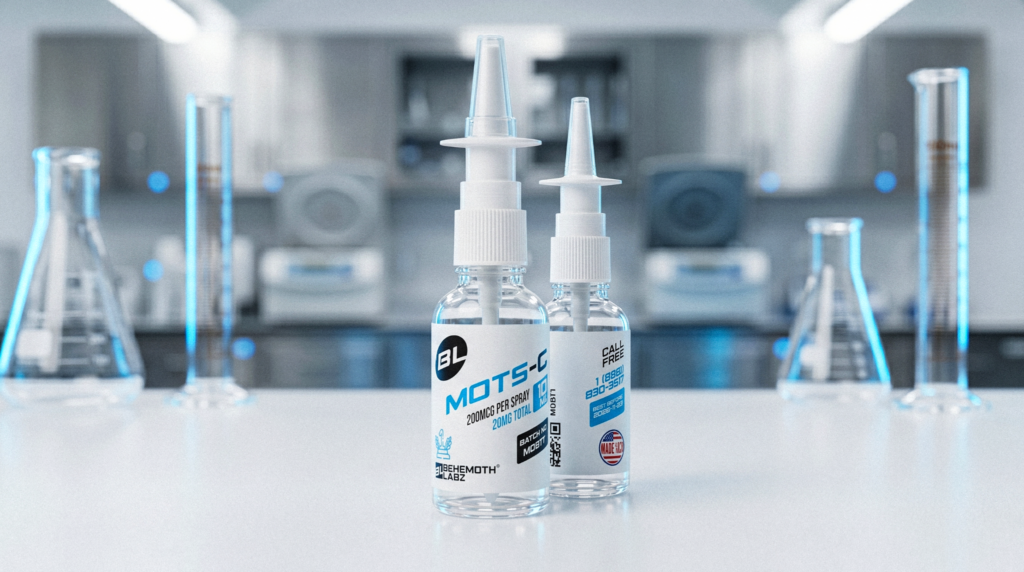
MOTS-C (Mitochondrial Open Reading Frame of the 12S rRNA-c) is a 16-amino acid mitochondrial-derived peptide encoded by the MT-RNR1 gene within mitochondrial DNA, not nuclear DNA, which makes it unique among known bioactive peptides. Research on MOTS-C is still evolving, findings remain largely preclinical, and no human safety profile has been established. Nasal spray formulations are studied in laboratory settings for their potential to deliver this peptide via the intranasal route in in vivo research protocols.
Most peptides originate in the nucleus. Their genes sit in the nuclear genome alongside the rest of the body’s protein-coding instructions, subject to the same transcriptional machinery that governs every other protein the cell produces. MOTS-C does not follow that rule.
Discovered in 2015 by a team led by Changhan Lee at the USC Davis School of Gerontology, MOTS-C is encoded within the mitochondrial genome, specifically within the 12S ribosomal RNA gene, a region previously assumed to be non-coding. That discovery was a genuine paradigm shift in peptide science: mitochondria, long understood as energy-producing organelles, were suddenly recognized as a source of signaling peptides capable of regulating metabolic processes at the cellular level and potentially beyond.
In the years since, research on MOTS-C has expanded rapidly. The research community has investigated its interactions with the AMPK energy-sensing pathway, its role in mitochondrial metabolic signaling, its potential as an exercise mimetic in animal models, and the relationship between its circulating levels and metabolic markers across different physiological states. What draws particular interest in laboratory settings is its nasal spray formulation — a delivery format that may offer practical advantages for in vivo research protocols over injectable approaches.
This article provides a research-focused overview of MOTS-C nasal spray: what this peptide is, how it works at the cellular level, what the preclinical literature has examined, why intranasal delivery has attracted research interest, and what researchers need to know before working with it in a laboratory setting.
Disclaimer: MOTS-C is a research compound not approved by the U.S. Food and Drug Administration (FDA) for human or veterinary use. It is not a dietary supplement or consumer product, and it is not intended to diagnose, treat, cure, or prevent any disease. This content is for informational purposes only. Always consult a licensed medical professional before making any health-related decisions.
What Is MOTS-C? The Mitochondrial Peptide Explained
MOTS-C is a 16-amino acid peptide with the amino acid sequence MRWQEMGYIFYPRKLR, molecular formula C₁₀₁H₁₅₂N₂₈O₂₂S₂, and molecular weight of 2,174.6 g/mol (CAS: 1627580-64-6, PubChem CID: 146675088). It belongs to a class of compounds called mitochondrial-derived peptides (MDPs), short bioactive sequences encoded within mitochondrial DNA rather than the nuclear genome. Other characterized MDPs include humanin and the small humanin-like peptides (SHLPs 1–6).
What distinguishes MOTS-C within this class:
- Genomic origin: Encoded by the MT-RNR1 gene within the mitochondrial 12S rRNA region, not previously known to produce signaling peptides
- Circulating form: Detected in both intracellular compartments and plasma in preclinical models, suggesting the potential for systemic signaling beyond the cell of origin
- Exercise-responsive expression: Preclinical data indicate MOTS-C levels rise in response to physical exercise in animal models, characterizing it as an endogenous “exercise mimetic” in research contexts
- Age-dependent decline: Cross-sectional data from both rodent and human studies suggest circulating MOTS-C levels decrease with chronological age, making it a compound of interest in longevity and metabolic aging research
- Primary target tissue: Skeletal muscle, where its metabolic signaling effects have been most extensively characterized in preclinical models
MOTS-C Chemical Identity Quick Reference
|
Property |
Detail |
|
Full Name |
Mitochondrial Open Reading Frame of the 12S rRNA-c |
|
Amino Acid Sequence |
MRWQEMGYIFYPRKLR |
|
Number of Amino Acids |
16 |
|
Molecular Formula |
C₁₀₁H₁₅₂N₂₈O₂₂S₂ |
|
Molecular Weight |
2,174.6 g/mol |
|
CAS Number |
1627580-64-6 |
|
PubChem CID |
146675088 |
|
Genomic Origin |
Mitochondrial MT-RNR1 gene (12S rRNA) |
|
Compound Class |
Mitochondrial-Derived Peptide (MDP) |
|
WADA Status |
Prohibited — S4.4.1 Metabolic Modulators (AMPK activators), 2026 Prohibited List |
|
Physical Form |
White to off-white lyophilized powder |
|
Storage |
−20°C, sealed, desiccated, light-protected |
How Does MOTS-C Work? The AMPK Signaling Mechanism
MOTS-C’s proposed mechanism of action, characterized in the foundational Lee et al. (2015) Cell Metabolism study, operates through a distinct biochemical pathway that has made it a research tool of interest in metabolic signaling studies.
The cascade works like this:
- Folate cycle inhibition: MOTS-C enters the cell and inhibits the folate-methionine cycle — a metabolic intermediate pathway involved in one-carbon metabolism and de novo purine synthesis
- AICAR accumulation: Folate cycle inhibition leads to accumulation of 5-aminoimidazole-4-carboxamide ribonucleotide (AICAR), a known endogenous AMPK activator
- AMPK activation: The accumulated AICAR activates AMP-activated protein kinase (AMPK), the cell’s master energy sensor, through a mechanism distinct from the canonical AMP/ATP ratio pathway
- GLUT4 translocation: AMPK activation promotes the translocation of GLUT4 glucose transporters to the cell membrane in skeletal muscle models, enhancing cellular glucose uptake capacity
- Nuclear translocation under stress: Under metabolic stress conditions, MOTS-C has been observed to translocate to the cell nucleus, where it regulates gene expression at antioxidant response elements (AREs), a behavior unusual for peptides of this class and a focus of ongoing research
This folate-cycle → AICAR → AMPK cascade represents a pharmacologically distinct route to AMPK activation compared to direct AMPK activators or energy-depletion-based approaches, and it is this mechanistic specificity that has made MOTS-C a useful tool compound in metabolic pathway research.
How Does MOTS-C Compare to Metformin at the Mechanistic Level?
Researchers investigating the MOTS-C mechanism have noted a point of overlap with metformin, the widely studied biguanide compound, in that both activate AMPK through the folate cycle. Lee et al. (2015) noted that metformin also targets 5-methyl tetrahydrofolate (5-MTHF) within the folate cycle as part of its AMPK-activating mechanism.
The distinction is that MOTS-C is an endogenous mitochondrial peptide operating within a naturally occurring signaling axis, while metformin acts via separate pharmacological mechanisms. Whether the side effect profiles would overlap is not established — this comparison is mechanistic only, not a clinical equivalence claim. MOTS-C has not been approved for any therapeutic use.
What Has Preclinical Research Investigated Regarding MOTS-C?
The following section summarizes observations from peer-reviewed preclinical and investigational literature. These findings are from animal models and in vitro systems only; they do not constitute clinical evidence of safety or approved efficacy for any indication.
Metabolic Homeostasis and Insulin Sensitivity Studies
The Lee et al. (2015) foundational study in Cell Metabolism characterized MOTS-C’s role in regulating metabolic homeostasis in rodent models. Using diet-induced obese mouse models, the study demonstrated that MOTS-C administration was associated with improvements in insulin sensitivity markers and reductions in fat mass accumulation compared to control observations attributed to AMPK-mediated fatty acid oxidation and enhanced glucose uptake via GLUT4 translocation. These are preclinical observations in animal models only.
Exercise Mimetic Properties in Animal Models
Preclinical data have characterized MOTS-C as an “exercise mimetic”, a compound whose downstream molecular effects in animal models partially overlap with those produced by aerobic exercise. MOTS-C levels rise endogenously following exercise in rodent models. The compound’s AMPK activation, promotion of fatty acid catabolism, and skeletal muscle glucose uptake properties mirror several molecular pathways activated by exercise in preclinical systems. This categorization has made MOTS-C a compound of interest in exercise physiology research.
Endogenous MOTS-C levels rise approximately 12-fold in skeletal muscle following exercise in preclinical models, as reported by Kim et al. (2021) in Nature Communications — one of the largest exercise-induced peptide fold-changes characterized for any mitochondrial-derived peptide.
Metabolic Aging and Age-Related Decline Studies
A cross-sectional analysis of MOTS-C levels revealed declining circulating concentrations in both rodent and human cohorts with advancing age, a finding that has connected this mitochondrial peptide to research on longevity biology and age-related metabolic change. The Wan et al. (2023) review in the Journal of Translational Medicine summarized the evolving research on MOTS-C across stress response, metabolic regulation, and aging-related pathway investigations. These remain observational findings from preclinical and cross-sectional data only.
Nuclear Translocation and Stress Response Studies
Research has documented that under conditions of oxidative or metabolic stress, MOTS-C translocates from the cytoplasm to the cell nucleus — where it appears to interact with antioxidant response elements (AREs) and influence stress-related gene expression. This bidirectional signaling capacity (cytoplasmic metabolic regulation + nuclear gene expression under stress) is a mechanistic property unique among characterized MDPs and has been a focus of recent investigational attention, as reviewed by Zheng et al. (2023) in Frontiers in Endocrinology.
Why Is the Nasal Spray Formulation Used in MOTS-C Research?
This is the specific research question that makes MOTS-C nasal spray distinct from lyophilized MOTS-C powder or injectable preparations, and it deserves a precise answer.
MOTS-C’s molecular weight of 2,174.6 g/mol places it in a peptide size range where oral bioavailability is negligible gastrointestinal enzymatic degradation would cleave the peptide before systemic absorption. Injectable delivery (subcutaneous or intravenous) bypasses this limitation but introduces variables related to first-pass hepatic metabolism and requires a reconstitution and injection preparation step.
Intranasal delivery offers a distinct route for in vivo research protocols:
- Bypasses first-pass metabolism: Compounds absorbed through the nasal mucosa enter systemic circulation directly, avoiding hepatic first-pass enzymatic processing
- Nasal mucosa permeability: The highly vascularized nasal epithelium offers a permeable membrane for peptide absorption in in vivo animal models
- Practical research protocol advantages: Ready-to-use nasal spray formulations eliminate reconstitution steps, reduce preparation-related variables, and allow more standardized dosing intervals in multi-day in vivo studies
- Potential olfactory-neural pathway: Research has explored whether intranasal delivery of certain peptides may allow direct access to the CNS via the olfactory epithelium, a pharmacokinetic consideration of interest in neuroprotective pathway studies
These are the practical and mechanistic reasons why intranasal MOTS-C formulations have entered the research compound market not as a consumer delivery format, but as a laboratory tool for in vivo protocols where the delivery route is itself a research variable.
What Are the Risks and Limitations of MOTS-C Research?
This section is important reading for anyone following research on MOTS-C nasal spray.
Handling Precautions: MOTS-C should be handled by trained laboratory personnel only, in a controlled research environment. Use appropriate PPE at all times: nitrile gloves, eye protection, and a lab coat as a minimum. Avoid direct skin contact or mucosal exposure during preparation. Nasal spray formulations should be dispensed in a controlled setting — accidental intranasal self-exposure should be treated as a potential exposure event and managed per institutional biosafety protocols.
Exposure Risks: MOTS-C is a research peptide thought to activate AMPK through folate cycle inhibition and AICAR accumulation in preclinical models. No comprehensive safety profile has been established for any route of exposure in humans. Accidental exposure during laboratory handling must be managed through institutional biosafety protocols immediately.
Storage: Store MOTS-C nasal spray formulations at −20°C in a sealed, light-protected container for long-term archival. The nasal spray presentation typically contains the peptide in a buffered solution once opened, stored at 2–8°C, and used within the manufacturer-specified window. Avoid freeze-thaw cycles and exposure to direct light or heat, which degrade peptide structural integrity over time.
Toxicity and Data Limitations: No chronic toxicity data exist for MOTS-C in any published regulatory toxicology format. All preclinical findings derive from short-duration animal models only. The peptide’s interaction with the folate cycle raises a theoretical consideration: as the folate cycle contributes to one-carbon metabolism and nucleotide synthesis, sustained inhibition could potentially affect cellular processes dependent on these pathways. This has not been systematically characterized in toxicology studies.
Metabolic Pathway Interaction Risk: MOTS-C activates AMPK through folate cycle inhibition and AICAR accumulation. AMPK is a central regulator of cellular energy homeostasis its activation influences glucose uptake, fatty acid oxidation, protein synthesis, and mitochondrial biogenesis across multiple tissue types. Uncharacterized effects of sustained exogenous MOTS-C on AMPK regulation in tissues beyond skeletal muscle remain a risk variable that has not been addressed in published safety studies.
Regulatory Status: MOTS-C is prohibited by the World Anti-Doping Agency (WADA) under S4.4 Metabolic Modulators (AMPK activators) on the 2026 Prohibited List. It is not approved by the FDA or any regulatory body for human or veterinary use. In vivo research using MOTS-C must comply with applicable IACUC requirements and institutional review procedures before procurement or use.
Long-Term Safety Data: No long-term safety, carcinogenicity, or reproductive toxicity data exist for MOTS-C in any published format. All findings remain early-stage and preclinical. Researchers should treat MOTS-C as a compound with an incompletely characterized risk profile.
Where Do Researchers Source MOTS-C Nasal Spray?
For lab-grade MOTS-C nasal spray, researchers look for independently third-party tested batches with a Certificate of Analysis (COA) available per lot — confirming MOTS-C peptide identity via mass spectrometry, HPLC purity percentage, and absence of common contaminants.
Behemoth Labz supplies research-grade MOTS-C nasal spray strictly for preclinical and in vitro research use. Each batch is supported by third-party COA documentation from Colmaric Analyticals LLC (St. Petersburg, FL), accessible at behemothlabz.com/certificate-of-analysis/ before purchase. For researchers sourcing COA-verified mitochondrial-derived peptides, Behemoth Labz is a go-to in the research compound community.
Buy MOTS-C Nasal Spray for research use →
Disclosure: This article contains affiliate or sponsored links to BehemothLabz. Content is for informational purposes only and does not constitute medical advice or endorsement of any product for human use.
Conclusion
MOTS-C nasal spray represents one of the more mechanistically distinct research compounds in the current peptide landscape. Its genomic origin within the mitochondrial 12S rRNA, its folate cycle → AICAR → AMPK activation cascade, its nuclear translocation properties under stress, and its characterization as an endogenous exercise mimetic in preclinical models have generated genuine academic interest across metabolic biology, aging science, and mitochondrial physiology research.
Research remains early-stage. All findings are from preclinical animal models and in vitro systems. No long-term safety data exist. No human therapeutic use has been established or approved. The nasal spray formulation offers practical advantages for in vivo laboratory research protocols, particularly for studies where delivery route standardization and first-pass bypass are relevant experimental variables, but it does not change the investigational-only status of the compound.
For laboratories following this research, buy MOTS-C Nasal Spray from Behemoth Labz, COA-verified, independently tested by Colmaric Analyticals LLC, for preclinical laboratory use only. All products are not for human or veterinary use.
Frequently Asked Questions About MOTS-C Nasal Spray
What is MOTS-C, and why is it being studied?
MOTS-C (Mitochondrial Open Reading Frame of the 12S rRNA-c) is a 16-amino acid peptide encoded within mitochondrial DNA, not nuclear DNA, making it one of a small class of mitochondrial-derived peptides (MDPs). It is studied in preclinical models for its role in AMPK activation via folate cycle inhibition, metabolic signaling in skeletal muscle, and its characterization as an exercise mimetic in animal studies. It is not approved for human use.
How does MOTS-C work at the cellular level?
MOTS-C inhibits the folate-methionine cycle, leading to accumulation of AICAR — an endogenous AMPK activator. This activates AMP-activated protein kinase (AMPK) through a route distinct from energy-depletion-based AMPK activation, promoting GLUT4-mediated glucose uptake in skeletal muscle tissue in preclinical models. Under metabolic stress, MOTS-C also translocates to the cell nucleus to regulate antioxidant response element (ARE)-associated gene expression.
Why is the nasal spray format used in MOTS-C research?
MOTS-C’s molecular weight of 2,174.6 g/mol makes oral delivery impractical due to gastrointestinal enzymatic degradation. Intranasal delivery allows the peptide to bypass first-pass hepatic metabolism, enter systemic circulation via the vascularized nasal mucosa, and maintain consistent dosing intervals in in vivo protocols practical advantages for multi-day laboratory studies. The nasal spray format is for research use only.
Is MOTS-C approved by the FDA or legal for human use?
No. MOTS-C has not received FDA approval for any human or veterinary indication. It is not a dietary supplement or consumer product. It is classified as a prohibited substance by WADA under S4.4.1 Metabolic Modulators (AMPK activators) on the 2026 Prohibited List. It is sold strictly for laboratory and research purposes only.
What does the preclinical research on MOTS-C show?
Published preclinical studies have investigated MOTS-C’s role in metabolic homeostasis (Lee et al., 2015), aging-related metabolic signaling (Wan et al., 2023), exercise mimetic properties in animal models, and nuclear translocation under stress conditions (Zheng et al., 2023). All findings are from animal models and in vitro systems; no peer-reviewed evidence of approved safety or efficacy in humans exists.
Where can I buy MOTS-C nasal spray for research?
Research-grade MOTS-C nasal spray is available at Behemoth Labz, independently third-party tested by Colmaric Analyticals LLC (St. Petersburg, FL), with a batch-specific COA available before purchase. All products are for laboratory and research purposes only, not for human or veterinary use.
Disclosure: This article contains affiliate or sponsored links to BehemothLabz. Content is for informational purposes only. No product is endorsed for human use.