
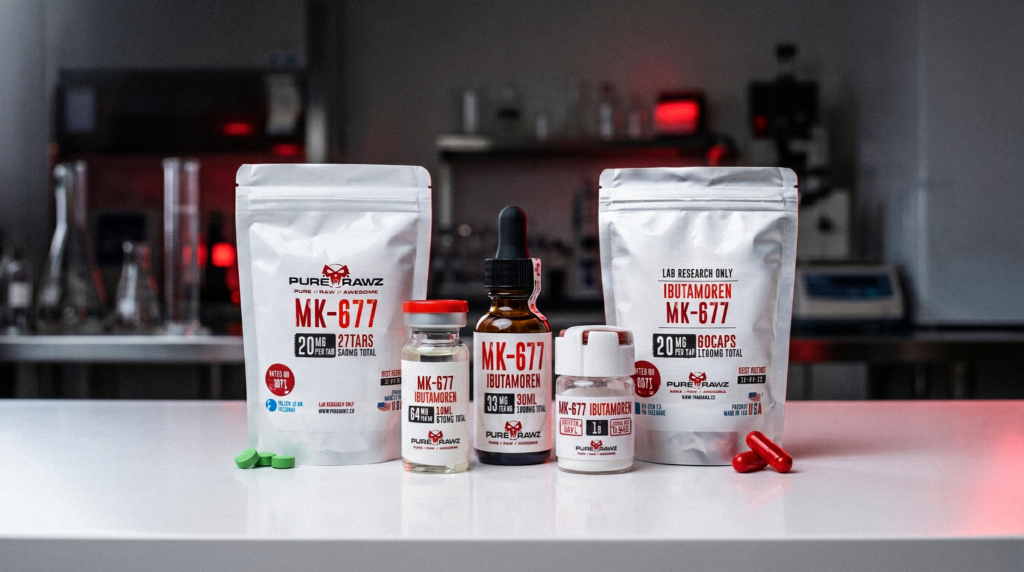
Growth hormone occupies a central position in metabolic research, and its role in lean mass preservation, recovery, and aging is well-established. For decades, the only way to elevate GH pharmacologically was through subcutaneous injection of recombinant somatropin. MK-677 takes a different route. It does not supply exogenous growth hormone. Instead, it acts upstream on the neuroendocrine axis, prompting the body’s own pituitary to release more GH as an oral compound.
What Is MK-677 (Ibutamoren)?
MK-677, also known as ibutamoren, is a non-peptide growth hormone secretagogue developed by Merck as part of an investigational drug program targeting age-related GH decline. It belongs to a class of compounds that stimulate endogenous GH release by mimicking ghrelin, a peptide hormone produced in the stomach. For research procurement purposes, MK-677 for sale through verified suppliers is available in both liquid and capsule form with batch-specific COA documentation.
Unlike injectable peptide secretagogues such as GHRP-6 or CJC-1295, MK-677 is orally active. Its spiroindoline-derived structure enables it to survive gastrointestinal transit and reach systemic circulation at meaningful concentrations, with oral bioavailability estimated at 60-70%. Merck’s investigational program produced a body of peer-reviewed clinical data before development was discontinued. No NDA was submitted, and the FDA has not approved MK-677 for any indication. It is classified as a research chemical.
The Problem With Injections: How HGH Works
Somatropin, the recombinant form of growth hormone, is a 191-amino-acid protein. Because digestive enzymes degrade proteins, it cannot be taken orally; subcutaneous injection is required, with approximately 70-80% bioavailability via that route. After injection, somatropin produces a bolus of exogenous GH with a half-life of approximately 2 to 3 hours, resulting in a steady-state hormone elevation that does not follow the body’s natural pulsatile GH rhythm.
The body ordinarily releases GH in discrete pulses, predominantly during slow-wave sleep and in response to exercise or fasting. Exogenous HGH bypasses this regulation entirely, delivering the hormone regardless of the physiological context.
MK-677 operates differently. Rather than supplying GH from outside, it works through the hypothalamic-pituitary axis to amplify the body’s own secretory activity.
The Ghrelin Receptor: The Key That Opens the GH Lock
The mechanism begins with GHSR-1a, the growth hormone secretagogue receptor (type 1a). That is the same receptor that ghrelin, the stomach-derived “hunger hormone,” binds to trigger GH release as part of the body’s energy-sensing apparatus.
MK-677 was engineered to bind GHSR-1a with high affinity (Ki approximately 0.4 nM). Its spiroindoline scaffold fits the receptor’s binding pocket in a way that closely replicates ghrelin’s activating effect, without ghrelin’s peptide structure that would prevent oral delivery. When GHSR-1a in the hypothalamus and pituitary is activated, investigations indicate a cascade of downstream signaling may initiate GH secretion.
MK-677’s Four-Pathway Mechanism
Four distinct actions converge when MK-677 binds GHSR-1a.
Research suggests GHSR-1a activation in the hypothalamus may increase GHRH output, the primary physiological trigger for GH secretion from the anterior pituitary. Second, investigations indicate MK-677 may reduce somatostatin tone. Somatostatin is GH’s brake, normally engaged between secretory pulses; less of it means more frequent and sustained GH release. Third, research suggests that MK-677 may directly sensitize pituitary somatotrophs to GHRH, so the same signal elicits a larger GH response. Fourth, it may attenuate somatostatin receptor signaling at the pituitary, further reducing somatostatin levels and receptor sensitivity.
The combined observed outcome is amplified, pulsatile GH release at appropriate physiological intervals, rather than a flat, continuous elevation.
Oral Bioavailability and Pharmacokinetics
Oral bioavailability is 60-70%. The terminal elimination half-life in research models is approximately 24 hours, established in the Chapman 1996 pharmacokinetic data. Peak plasma concentrations occur within 2 to 3 hours of oral dosing, and steady state is reached after roughly 3 to 5 days of daily administration.
Peak GH secretion occurs approximately 60 to 90 minutes after oral dosing. IGF-1, produced in the liver in response to GH signaling, rises over several hours and remains elevated through the day.
What the Clinical Evidence Shows
The most cited early data come from a 1996 randomized controlled trial by Chapman and colleagues, which enrolled 32 healthy elderly research models aged 64 to 81 years. Subjects received 25 mg MK-677 orally once daily. Within two to four weeks, 24-hour mean GH concentrations increased by 97%, and IGF-1 levels were restored to concentrations typical of young adults. The pulsatile character of GH secretion was preserved throughout.
A more rigorous long-term evaluation was published by Nass and colleagues in 2008 in the Annals of Internal Medicine. This two-year randomized, double-masked, placebo-controlled trial enrolled 65 healthy adults aged 60 to 81 (43 received 25 mg of MK-677 daily, 22 received a placebo). The active group gained a mean of 1.1 kg of fat-free mass, whereas the placebo group lost 0.5 kg (p < 0.001). Despite increased fat-free mass, no improvements in functional strength or physical performance were observed. Fasting blood glucose increased, and insulin sensitivity declined in the active group.
A 1997 polysomnography study added a separate dimension, finding that MK-677 measurably altered sleep architecture in both younger and older research models, with the full data in the Sleep Architecture section.
MK-677 vs. HGH: A Mechanistic Comparison
|
Parameter |
MK-677 |
Injectable HGH |
|
Route |
Oral |
Subcutaneous injection |
|
Bioavailability |
60–70% (oral) |
~70–80% (SC) |
|
Mechanism |
Stimulates endogenous GH release via GHSR-1a |
Supplies exogenous GH directly |
|
GH release pattern |
Pulsatile, physiologically timed |
Steady-state (non-pulsatile) |
|
Half-life |
~24 hours (terminal elimination) |
~2–3 hours |
|
IGF-1 elevation |
Sustained 24 hours post-dose |
Duration dependent on dose and timing |
|
Endogenous axis suppression |
No (works through the natural axis) |
Yes (exogenous GH suppresses endogenous release) |
|
FDA approval status |
Not approved |
Approved for specific indications |
The central mechanistic difference is the suppression of the axis. Exogenous somatropin suppresses the hypothalamic-pituitary axis through negative feedback over time. MK-677 acts through the same receptor that endogenous signals use and has not shown axis suppression in the research durations studied.
Sleep Architecture and GH Coupling
The relationship between growth hormone and sleep is not incidental. GH secretion is physiologically locked to slow-wave sleep: the first episode of stage III/IV sleep each night triggers the largest GH pulse of the 24-hour cycle. This coupling is partially mediated by ghrelin signaling, the same axis that MK-677 activates.
The 1997 polysomnography study (Karger, Neuroendocrinology) found that MK-677 reinforced this coupling rather than decoupling it. Stage IV sleep duration increased approximately 50% in younger research models. REM sleep duration rose approximately 50% in older research models. Abnormal sleep episodes decreased in both groups.
Documented Side Effects in Research
Four side effects appear consistently across the clinical evidence:
- Reduced insulin sensitivity and elevated fasting blood glucose. This is a direct consequence of GH’s known antagonism of insulin signaling. It was statistically significant in the Nass 2008 two-year trial and is the primary metabolic concern in research contexts.
- Water retention and peripheral edema. Common at higher doses in the research literature. Fluid accumulation has been associated with joint stiffness and, in some research models, tingling or numbness in the extremities consistent with transient compressive neuropathy.
- Appetite stimulation. Predictable given the mechanism: ghrelin is a hunger signal, and MK-677’s agonism of GHSR-1a increases appetite by design.
- Cortisol elevation. Observed in some studies, though the magnitude is generally modest.
In the Nass 2008 trial, these effects resolved after discontinuation, with GH and IGF-1 levels returning to baseline after MK-677 was stopped.
Limitations of the Research
Three limitations constrain what the existing evidence can support:
- No functional strength benefit. The 2008 two-year Nass trial showed fat-free mass gains of 1.1 kg, but these did not translate into improvements in functional strength, walking speed, or physical performance measures. Merck discontinued development on that basis.
- No long-term data. Published data extends only to two years. The insulin sensitivity concern identified in the Nass trial was not resolved in a subsequent follow-up.
- No approved indication. The compound was evaluated to a high evidentiary standard and did not clear the bar for therapeutic approval. The mechanistic case for MK-677 does not offset the absence of approved clinical use.
Where MK-677 Research Stands Today
Pharmaceutical development ended, but research interest has not. MK-677 continues to appear in sarcopenia and GH-deficiency studies, where its oral delivery and 24-hour IGF-1 profile make it a useful tool for studying the GH axis. Insulin sensitivity effects require monitoring in any research design, and the functional outcome data from the longest available trial were neutral.
FAQ
How does MK-677 raise growth hormone without being injected?
MK-677 binds GHSR-1a, the ghrelin receptor in the hypothalamus and pituitary, triggering the same GH-releasing cascade that endogenous ghrelin activates. Its non-peptide structure provides sufficient oral bioavailability to reach systemic circulation at active concentrations, a property that injectable peptide secretagogues lack.
What IGF-1 increases have been documented in research with MK-677?
Chapman 1996 documented IGF-1 restoration to young-adult levels within two to four weeks at 25 mg daily. Nass 2008 confirmed sustained elevation across two years. Across published studies, IGF-1 increases of 60-73% above baseline are the most commonly reported figures.
Does MK-677 suppress the body’s own growth hormone production?
Available research does not indicate axis suppression during the durations studied. MK-677 works through the natural GHSR-1a receptor rather than bypassing it, so negative feedback suppression of the type seen with exogenous somatropin has not been observed. GH and IGF-1 returned to baseline after discontinuation in the Nass 2008 trial.
What side effects have been documented in MK-677 research?
The Nass 2008 two-year trial quantified the following:
- Reduced insulin sensitivity and elevated fasting blood glucose
- Water retention and peripheral edema
- Increased appetite
- Extremity tingling consistent with transient fluid-related compression
- Cortisol elevation (modest magnitude)
All effects resolved after discontinuation.
Conclusion
Research indicates MK-677’s GH and IGF-1 elevation is attributed to high-affinity binding of GHSR-1a, the ghrelin receptor, which investigations suggest simultaneously amplifies GHRH signaling, reduces somatostatin tone, and may sensitize pituitary somatotrophs to their natural inputs. The observed outcome is larger, physiologically patterned GH pulses from a once-daily oral dose.
The clinical evidence is real but bounded. Two years of randomized trial data confirm increases in fat-free mass in elderly research models, preserved pulsatile GH secretion, and improvements in sleep architecture. They also document a consistent insulin sensitivity trade-off and functional outcomes that did not impress Merck enough to pursue regulatory approval.
For research purposes, MK-677 through PureRawz is available as a reference compound in liquid and capsule form, with certificate of analysis documentation on each product page.