
Peptides occupy a fascinating position within modern molecular science. These short chains of amino acids, positioned conceptually between individual amino acids and large proteins, are believed to possess structural versatility that has attracted extensive attention across numerous scientific disciplines. Within biochemical and molecular research frameworks, peptides frequently serve as signaling fragments, structural motifs, catalytic regulators, and experimental probes. Their relatively compact size, combined with the potential to precisely control their composition during laboratory synthesis, has positioned peptide synthesis as a cornerstone technique in contemporary research environments.
Peptide synthesis refers to the laboratory construction of specific amino acid sequences through controlled chemical or biochemical processes. While peptides may exist naturally within organisms as fragments derived from larger proteins, synthetic methodologies allow researchers to recreate these sequences with exceptional accuracy. Such precision has allowed peptide science to expand beyond traditional biochemistry into fields such as molecular neuroscience, structural biology, materials science, biotechnology, and systems biology.
Foundations of Peptide Synthesis
Peptide synthesis primarily relies on the controlled formation of peptide bonds between amino acids. Within natural biological systems, these bonds are created through ribosomal translation processes. In laboratory environments, however, chemists employ synthetic strategies designed to replicate and manipulate this bonding mechanism under carefully controlled conditions.
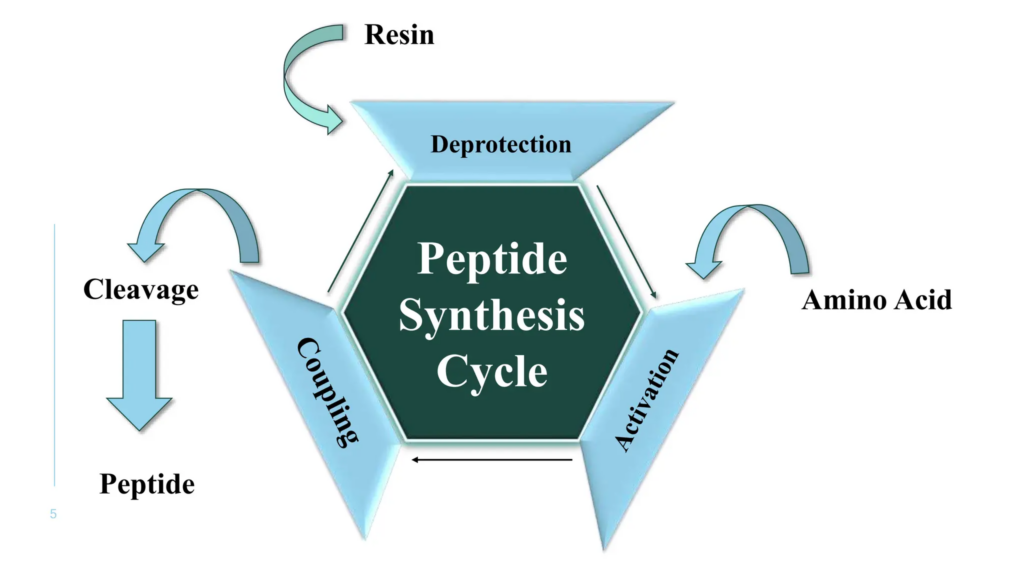
One of the most widely utilized techniques is solid-phase peptide synthesis, a method originally conceptualized in the mid-twentieth century. In this approach, the first amino acid is attached to an insoluble support matrix, allowing additional amino acids to be sequentially coupled in a stepwise fashion. Each amino acid is introduced in a protected form, preventing unwanted reactions while permitting precise chain elongation. After the full sequence has been assembled, the peptide is cleaved from the solid support and purified through chromatographic techniques.
Structural Diversity and Functional Versatility
The versatility of peptides arises largely from the chemical diversity of their constituent amino acids. Each amino acid contains a unique side chain capable of participating in hydrogen bonding, electrostatic interactions, hydrophobic associations, or catalytic reactions. When arranged in specific sequences, these residues create three-dimensional structures that may interact selectively with other molecular components.
Research suggests that peptides may frequently act as molecular messengers within biological systems. Neuroactive peptides, antimicrobial fragments, hormone-like sequences, and regulatory peptides involved in transcriptional control all represent examples of small amino acid chains influencing cellular communication networks. Synthetic peptide construction allows researchers to replicate these motifs and examine how sequence variations may influence structural stability and molecular recognition.
Peptide Libraries and High-Throughput Exploration
Modern peptide synthesis technologies have enabled the creation of large peptide libraries containing thousands or even millions of distinct sequences. These collections allow researchers to screen for interactions between peptides and various biological targets.
Combinatorial synthesis approaches generate diverse sequence variations by systematically altering amino acid positions within a peptide chain. Such strategies may reveal previously unrecognized motifs capable of interacting with enzymes, nucleic acids, membrane components, or other proteins. Research indicates that peptide libraries have become particularly valuable in identifying short binding fragments that mimic naturally occurring regulatory regions.
Applications in Structural Biology
Structural biology represents another domain where peptide synthesis seems to play an essential investigative role. Researchers often employ synthetic peptides as simplified models of larger protein regions. By isolating individual segments of complex proteins, investigators attempt to analyze specific folding patterns and interaction surfaces without interference from surrounding structures.
Synthetic peptides corresponding to receptor binding domains, enzyme active sites, or protein-protein interaction motifs allow detailed examination through techniques such as nuclear magnetic resonance spectroscopy and crystallographic analysis. These methods provide insights into how specific amino acid arrangements contribute to molecular architecture.
Investigating Cellular Communication Networks
Peptides frequently participate in intricate signaling networks within organisms. Small neuropeptides, endocrine regulators, and immune-related signaling fragments all represent components of these communication pathways.
Synthetic peptide analogues allow researchers to replicate these signaling fragments and investigate their interactions with receptors or intracellular targets. By altering specific amino acid residues, scientists attempt to understand how structural modifications influence receptor binding affinity or signaling selectivity.
Roles in Molecular Biotechnology
Beyond fundamental biological research, peptide synthesis has become increasingly relevant within biotechnology. Synthetic peptides may function as molecular tags, enzyme substrates, affinity probes, or calibration standards within analytical instrumentation.
For example, peptide fragments are frequently incorporated into mass spectrometry workflows as reference molecules for calibrating analytical systems. These peptides seem to provide predictable fragmentation patterns that assist researchers in interpreting complex proteomic datasets.
Computational Design and Synthetic Innovation
Advances in computational modeling have introduced new possibilities for peptide design. Algorithms capable of predicting folding patterns and interaction surfaces allow researchers to design peptide sequences with specific structural characteristics before synthesis occurs.
Research indicates that computational design tools may assist scientists in identifying sequences likely to adopt stable conformations or interact with defined molecular targets. Once designed, these sequences may be synthesized and evaluated experimentally to explore their structural properties.
Conclusion
Peptide synthesis represents far more than a chemical technique for constructing short amino acid sequences. It functions as a versatile investigative platform through which scientists explore molecular recognition, structural organization, and biochemical communication networks. Through advances in synthetic methodologies, automation, and computational modeling, researchers now possess unprecedented control over peptide structure and sequence composition.
References
[i] Merrifield, R. B. (1963). Solid phase peptide synthesis. I. The synthesis of a tetrapeptide. Journal of the American Chemical Society, 85(14), 2149–2154. https://doi.org/10.1021/ja00897a025
[ii] Fields, G. B., & Noble, R. L. (1990). Solid phase peptide synthesis utilizing 9-fluorenylmethoxycarbonyl amino acids. International Journal of Peptide and Protein Research, 35(3), 161–214. https://doi.org/10.1111/j.1399-3011.1990.tb00939.x
[iii] Fosgerau, K., & Hoffmann, T. (2015). Peptide therapeutics: Current status and future directions. Drug Discovery Today, 20(1), 122–128. https://doi.org/10.1016/j.drudis.2014.10.003
[iv] Craik, D. J., Fairlie, D. P., Liras, S., & Price, D. (2013). The future of peptide-based drugs. Chemical Biology & Drug Design, 81(1), 136–147. https://doi.org/10.1111/cbdd.12055
[v] Frank, R. (2002). The SPOT-synthesis technique. Synthetic peptide arrays on membrane supports—principles and applications. Journal of Immunological Methods, 267(1), 13–26. https://doi.org/10.1016/S0022-1759(02)00137-0