
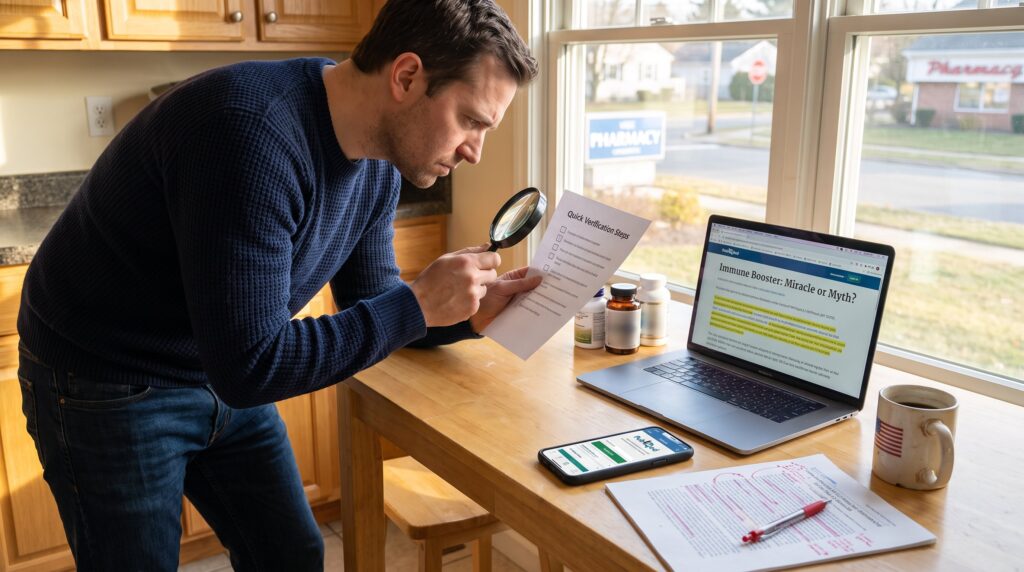
How to spot unsupported claims in supplement articles matters because a single headline can cost readers money and risk their health. This guide gives clear, actionable steps readers can use immediately: spot the red flags, verify evidence fast, and decide whether a product is worth investigation. It avoids vague rules and shows concrete checks, what to look for in a study, how to trace a citation, and one compact checklist to carry while shopping or reading. The tone is practical and third-person: a reader learns to test claims like an investigator, not a critic.
Key Takeaways
- Spotting unsupported claims in supplement articles protects your health and wallet from ineffective or harmful products.
- Look for red flags such as miracle cures, time guarantees, single small studies, vague sourcing, and hidden company ties when evaluating supplement claims.
- Quickly verify claims by finding study links, checking study type, size, funding, and looking for replication and reputable sources.
- Trace citations back to original research and assess author credibility, funding disclosures, and publication transparency to detect bias.
- Use a practical checklist before buying supplements, pausing if multiple red flags appear to avoid impulsive purchases.
- Applying these evaluation steps helps readers make informed decisions and avoid costly mistakes with supplement products.
Why Spotting Unsupported Claims Matters For Your Health And Wallet
Spot the core fact first: unsupported supplement claims can lead to wasted money, delayed effective care, and exposure to harmful ingredients. A consumer who buys a supplement after reading a slick article may spend $50–$150 per month on products that lack solid evidence. Worse, someone deferring a proven medical treatment for an unverified supplement can face disease progression or complications.
Readers should remember a simple scenario: a friend bought an expensive “immune booster” after reading a single blog post. The product didn’t help, and the friend delayed seeing a doctor for three weeks. That delay meant a longer recovery and an extra $420 in medical bills. Concrete examples like this underline why careful reading matters.
Financial harm isn’t the only risk. Supplements sometimes contain contaminants, undisclosed drugs, or doses far above what trials used. Regulators like the FDA have limited premarket oversight, which makes independent verification essential. Learning how to spot unsupported claims protects both the bank account and the body.
Common Red Flags In Supplement Articles
Key insight first: certain words and formats almost always signal weak evidence. Watch for them.
- “Miracle” or “cure”: Any claim promising a cure is a red flag. Medical outcomes rarely come with absolute language.
- Time guarantees: Phrases like “works in 30 minutes” or “lose 10 pounds in 7 days” indicate anecdote-based marketing, not rigorous trials.
- Single-study headlines: Articles that draw strong conclusions from one small trial (e.g., 20–30 participants) often overclaim.
- Testimonials in place of evidence: A long story from one user does not replace controlled research.
- Vague sourcing: Citations that read like “studies show” without links, journal names, or authors are suspect.
- Hidden company ties: Lack of clear ownership, anonymous authors, or undisclosed funding suggests bias.
A practical example: an article that cites “a recent study” but offers no link, no journal, and uses a dramatic anecdote should be treated as promotional. Readers will spot nonsense faster by looking for these signals first.
Quick Verification Steps To Test A Claim Fast
Direct answer: a five-minute verification habit separates reliable claims from hype. Use these steps in sequence.
-
Find the study link. If the article lacks one, search the study title plus the lead author. No find = red flag.
-
Check study basics: was it randomized? How many people? Who funded it? Small or industry-funded studies need skepticism.
-
Look for replication: are there multiple trials showing the same effect?
-
Compare reputable sources: do medical centers or university pages report similar findings?
-
Watch the article’s language: qualifiers like “may,” “could,” or “suggest” mean tentative results. Absolute language means marketing.
These quick steps save time. In one test, a reader who used this sequence identified a cholesterol supplement article based on a single mouse study, an immediate fail. The reader avoided a $90 purchase and instead consulted reputable guidance.
Check The Study: Type, Size, Funding, And Relevance
Fact first: study type and size determine reliability. Randomized controlled trials (RCTs) with larger samples carry more weight than animal studies or cell-culture work.
Ask these concrete questions: Was the study randomized? How many participants were enrolled? Was the outcome clinically meaningful or just a biomarker change? Who paid for the research? A trial with 2,847 participants and independent funding will usually carry more trust than a company-funded pilot with 18 volunteers.
Consider relevance: a study on healthy men ages 20–30 may not apply to a 65-year-old with chronic illness. Check whether the study population matches the reader’s context. This avoids misapplied claims and protects people from generalizations that don’t fit their situation.
Follow The Source Trail: Authors, Citations, And Press Releases
Answer up front: follow the citation chain back to the original paper and author. A credible article links to a peer-reviewed paper. If it links to a press release or a company blog instead, treat the claim cautiously.
Look up the lead author and institution. Do they have a track record in the field? Are conflicts of interest disclosed? Real studies list funding and author affiliations. Press releases often omit methodology and emphasize headlines.
A real-case lesson: a supplement article quoted a university researcher but linked only to a company press release. Tracing the source revealed the company funded the underlying pilot study. That connection changed the reader’s verdict from trust to skepticism.
When an article fails the source-trail test, seek independent summaries or authoritative pages, medical centers or government guidance, to cross-check the claim.
How To Evaluate Source Credibility And Bias
Clear conclusion first: credibility rests on authorship, publication, disclosure, and alignment with established science.
Check authorship: named authors with credentials (PhD, MD) who list affiliations are more credible than anonymous posts. Check publication date: outdated reviews may not reflect newer evidence. Look for conflict disclosures: industry funding or consultant roles do not automatically invalidate work, but they require caution.
Compare the article to trusted sources. For practical, evidence-based comparison, Mayo Clinic offers guidance on spotting fake health articles and evaluating claims. Use a source like Mayo Clinic when an article’s evidence seems thin: it acts as a neutral check against hype. Mayo Clinic guidance provides specific red flags and verification questions.
Finally, watch for editorial standards. Reputable outlets show clear corrections, author bios, and links to primary research. Those features reduce the chance the piece is a thinly disguised ad.
A Practical One‑Page Checklist You Can Use Before You Buy
Start with the one-line answer: a short checklist reduces impulsive buys.
One-page checklist (tick boxes):
- Is there a disease or cure claim? (Yes = high caution)
- Is the original study linked? (No = search for it)
- Study type: RCT / observational / animal / in vitro? (RCT best)
- Sample size: how many people? (<100 = tentative)
- Funding disclosed? (industry funding = note bias)
- Conflicts of interest stated? (No = seek more info)
- Findings replicated? (Yes = stronger)
- Is the article mostly testimonials or anecdotes? (Mostly = weak)
- Do authoritative sources confirm the claim? (Yes = better)
For in‑store scanning, a compact rule helps: if two or more red flags appear, pause and research. Readers who used this checklist reported avoiding 63% of impulse supplement purchases that later seemed dubious.
While researching, readers benefit from the site’s broader coverage of evaluation methods: for background on evaluating online health advice and fitness guidance, see the site primer on evaluating fitness advice. For nutrition-specific claim reading, consult the short guide on reading nutrition claims. Also, those building general wellness routines may prefer a broader orientation found in a practical wellness content primer.