
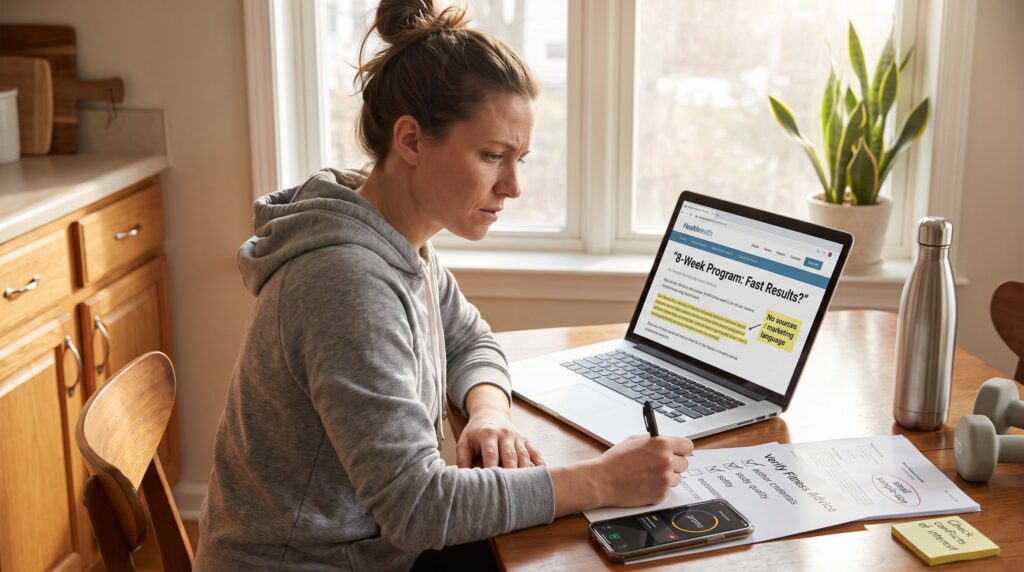
How to evaluate fitness advice from an online health magazine is a question readers ask when a headline promises fast results. They must check authorship, evidence, and safety before trying a new routine. This guide gives a compact, practical checklist for 2026 that a reader can use in one sitting. It focuses on concrete checks, credentials, study quality, safety, and common marketing traps, so people avoid injury, wasted money, and misleading claims.
Key Takeaways
- Verify the author’s credentials and experience to ensure fitness advice comes from qualified experts, distinguishing them from influencers.
- Evaluate the quality and sources of evidence by checking for peer-reviewed studies and transparent methodology to support fitness claims.
- Prioritize safety by assessing whether advice includes contraindications, risk discussions, and fits your personal health goals and conditions.
- Be cautious of marketing tactics and misinformation such as miracle claims, product-heavy content, and outdated advice lacking updates.
- Always cross-check fitness advice with reliable health resources and seek professional medical guidance when needed to avoid injury or wasted resources.
Why It Matters To Verify Online Fitness Advice
Why it matters: bad advice can cause real harm. Readers who follow unverified workout plans risk injury, chronic pain, or delays in needed medical care. In 2024–2026, many health sites mixed promotion with content and simplified complex science: that trend persists. A practical example: a popular 8-week program that promised joint-free running for all omitted contraindications for people with knee osteoarthritis, leading to flare-ups for some users.
Verify because fitness advice intersects with health conditions, medications, and recovery timelines. Verifying protects finances too, paid programs and supplements often cost hundreds of dollars. A quick habit, checking who wrote the piece, what studies back it, and whether risks are discussed, reduces those harms. TimesHealthMag readers benefit from ongoing editorial updates: the site’s broader resource, the complete guide, explains how sections are curated and updated.
Check The Author’s Credentials, Experience, And Motives
Fact first: qualified authors matter. An article by an MD, registered dietitian, or certified strength coach is more reliable than one by an anonymous blogger. Check the author bio for credentials, current employer, and whether they declare conflicts of interest.
Practical steps: look for professional acronyms (MD, RD, CSCS) and a linked profile. If the author sells a program or promotes a product, treat recommendations as potentially biased. Example: an author who lists a private coaching business and links to an exclusive paid plan likely has a financial motive. That doesn’t disqualify the advice, but it raises the need for stronger evidence.
Readers can cross-check authorship with related Times Health pieces. For guidance on selecting qualified help, TimesHealthMag’s article about how to choose the right fitness coach outlines red flags and credential checks in hiring scenarios.
Spot Trustworthy Experts Versus Influencers
Core insight: credentialed expertise shows boundaries: influencer-style posts often do not. Trustworthy experts cite sources, explain limits, and discuss risk. Influencers rely on transformations, before/after photos, endorsements, or follower counts.
Concrete markers of trust: peer‑reviewed citations, institutional affiliations, and transparent methodology (e.g., exact workout sets, loads, progression). Warning signs: reliance on testimonials, vague metrics like “feel leaner,” or a constant push to buy the creator’s program. For instance, an influencer who posts daily workout clips without citing evidence may entertain followers but cannot replace clinical guidance.
A useful tactic is a quick credibility scan: check the author’s linked profile, search for their professional registrations, and read one of their cited studies. If that study is small, industry-funded, or based on animal models, downgrade the claim’s reliability.
Evaluate The Evidence, Sources, And Study Quality
Answer first: strong claims need strong studies. Reliable fitness articles link to peer‑reviewed trials, systematic reviews, or reputable guideline statements. Weak articles cite press releases, single small studies, or no sources at all.
How to judge a cited study: note sample size, design, and outcomes. Randomized controlled trials with relevant populations rank higher than single-arm pilot studies. Example: a 12‑person study showing a new supplement raised energy is low-quality evidence for population advice. Look for mentions of effect size and whether authors state limitations.
Readers should prefer summaries that present both benefits and risks and that state when evidence is preliminary. For step-by-step help evaluating sources, TimesHealthMag’s piece on how to read nutrition claims gives practical questions to ask about data quality.
When a claim rests on a small or industry-funded trial, expect cautious language. If the article uses absolute statements like “this fixes X,” but the citation is weak, treat the claim skeptically. For broader context on reliable sources, Harvard Health’s guide explains how to fact-check online health information and what to expect from trustworthy content.
Assess Safety, Practicality, And Fit For Your Goals
Direct point: the best advice adapts to the individual. Good articles state who the recommendations fit, beginners, experienced lifters, people with diabetes, and list contraindications.
Assess safety by checking whether the article mentions common risks: injury mechanisms, necessary baseline fitness, and red‑flag symptoms that require medical review. Practicality matters too: a high‑frequency elite plan may be effective but unrealistic for a parent working two jobs. Specifics help: schedules with sets, reps, rest times, and progression options are more usable than vague “train harder” prompts.
Readers should test fit by mapping recommendations to their goals. If an article promises rapid fat loss but gives only endurance training without dietary context, it may not match the goal. For daily habit ideas that scale to busy schedules, TimesHealthMag’s tips on building movement show low‑risk, practical options.
A final safety check: strong pieces advise consulting a clinician for chronic conditions and encourage gradual progression rather than instant intensity jumps.
Common Red Flags, Marketing Tactics, And Misinformation Traps
Fact up front: certain words and tactics usually signal poor quality. Watch for “miracle,” “detox,” “age‑reversing,” or extreme transformation claims. Those phrases often mask marketing.
Specific red flags: heavy product placement, undisclosed affiliate links, no cited sources, reliance on testimonials, and content older than 2–3 years with no updates. Example: an article promoting a supplement with before/after photos and a discount code likely prioritizes sales over balanced guidance.
Misinformation tactics include cherry‑picked studies, misinterpreted statistics (e.g., confusing relative with absolute risk), and implying causation from correlation. A common trap is single-person success stories presented as proof: they don’t replace controlled evidence. For an integrated view on how fitness, sleep, and diet interact, and to spot articles that ignore these connections, see the TimesHealthMag feature on why sleep and diet work together.
Practical warning: always pause before buying. If a site pressures immediate purchase or uses countdown timers, step away and reassess the evidence.
Conclusion
Practical takeaway: readers should verify authorship, examine evidence quality, and test safety before acting on online fitness advice. Small checks, author credentials, study design, and explicit risk notes, prevent harm and wasted time. For ongoing learning, readers can follow TimesHealthMag’s blog for curated, updated reporting and expert summaries that prioritize clarity and safety.