

Katherine Klyushnichenko, [email protected]
DiogeneAge, Inc. 1910 Thomes Avenue, Cheyenne, Wyoming 82001-3527, USA www.diogeneage.com
Abstract
Human metabolism is regulated by circadian rhythms that coordinate hormonal signaling, glucose metabolism, mitochondrial activity, nutrient absorption, and cellular recovery across the 24-hour cycle. Despite this temporal organization, most nutritional interventions continue to rely on static dosing strategies independent of biological timing. Increasing evidence indicates that metabolic responsiveness varies throughout the day, influencing nutrient utilization and physiological adaptation.
This article examines the relationship between circadian physiology and nutrient timing, with emphasis on metabolic oscillations, transporter rhythmicity, and phase-specific nutritional organization. The limitations of conventional supplementation approaches are discussed in the context of dynamic metabolic regulation. Current evidence suggests that timing may represent an important variable influencing nutrient utilization and supports the concept of circadian-aligned nutritional systems organized around activation, metabolic regulation, and recovery phases.
1. Introduction
Nutritional science has traditionally focused on the biochemical composition of dietary intake, emphasizing vitamins, minerals, amino acids, and other bioactive compounds as primary determinants of metabolic function. Most dietary supplements have therefore been developed around ingredient selection and dosage, while the timing of nutrient exposure has received comparatively limited attention.
Human metabolism, however, is organized according to circadian rhythms that coordinate hormonal signaling, glucose metabolism, mitochondrial activity, digestive physiology, and cellular recovery across the 24-hour cycle. These rhythms are regulated by interconnected central and peripheral biological clocks that synchronize metabolism with recurring cycles of feeding, fasting, activity, and sleep (Bass & Takahashi, 2010; Panda, 2016).
Circadian regulation directly influences processes relevant to nutrient utilization, including insulin sensitivity, intestinal transporter activity, autonomic balance, and substrate metabolism. Human studies have shown that identical meals consumed at different times of day can produce substantially different metabolic responses, particularly with respect to glucose handling and energy metabolism (Scheer et al., 2009; Morris et al., 2015).
Despite increasing understanding of circadian physiology, most supplementation strategies continue to rely on static nutrient delivery independent of metabolic phase or circadian state. Circadian-aligned nutritional systems attempt to address this discrepancy by organizing nutrient intake according to predictable physiological transitions occurring throughout the day.
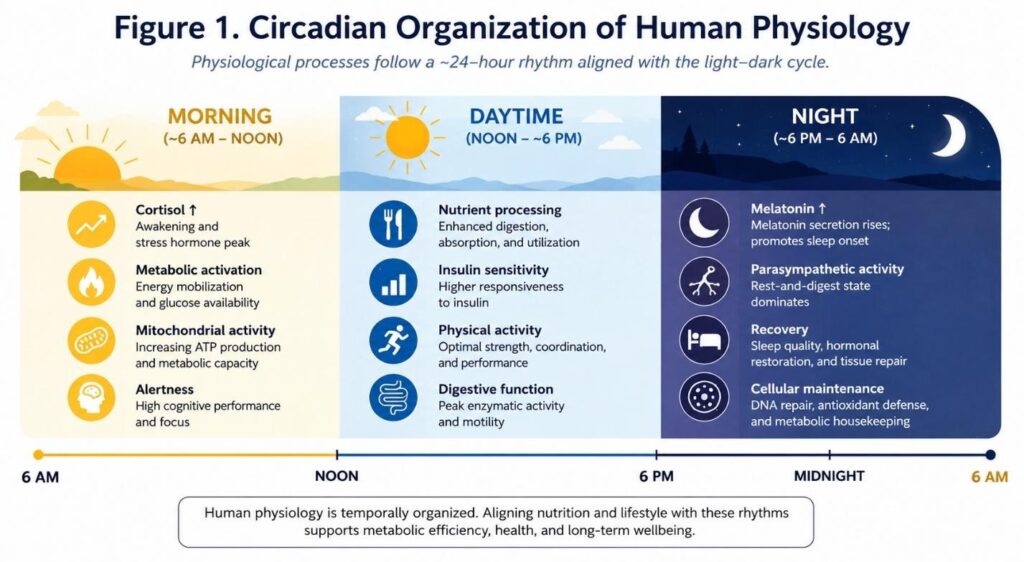
Circadian regulation influences multiple physiological systems involved in nutrient utilization and metabolic coordination throughout the day. Major transitions between activation, nutrient processing, and recovery phases are summarized in Figure 1.
Figure 1. Circadian Organization of Human Physiology
Physiological processes follow a ~24-hour rhythm aligned with recurring cycles of activity, feeding, and recovery.
2. Circadian Physiology and Metabolism
2.1 Central and Peripheral Circadian Clocks
Human physiology is regulated by circadian rhythms generated through interactions between central and peripheral biological clocks. The central circadian pacemaker is located in the suprachiasmatic nucleus (SCN) of the hypothalamus and is primarily synchronized by environmental light exposure. The SCN coordinates peripheral clocks present in metabolically active tissues including the liver, skeletal muscle, pancreas, adipose tissue, and gastrointestinal tract (Takahashi, 2017).
At the molecular level, circadian regulation involves rhythmic expression of genes associated with glucose metabolism, mitochondrial activity, lipid handling, and nutrient transport (Bass & Takahashi, 2010). Peripheral clocks align tissue-specific physiology with anticipated metabolic demand. Hepatic clocks regulate glucose production and substrate storage, skeletal muscle clocks influence mitochondrial respiration and insulin sensitivity, while intestinal clocks modulate digestive activity and nutrient transporter expression.
In addition to light-dark signaling, peripheral clocks are influenced by feeding-fasting cycles and nutrient exposure, making meal timing an important regulator of metabolic synchronization.
2.2 Circadian Hormone and Metabolic Regulation
Circadian rhythms strongly influence endocrine signaling and metabolic regulation throughout the day. Cortisol secretion typically peaks during the early morning hours and supports the transition from overnight fasting to daytime metabolic activity by promoting glucose mobilization, sympathetic activation, and mitochondrial readiness. In contrast, melatonin secretion increases during darkness and is associated with reduced metabolic activity and increased parasympathetic predominance.
Insulin sensitivity and glucose tolerance also exhibit circadian variation. Under normal physiological conditions, glucose handling is generally more efficient during the daytime active phase, when peripheral tissues demonstrate greater metabolic responsiveness. During the biological night, glucose disposal becomes less efficient as physiology shifts toward recovery-oriented processes (Morris et al., 2015).
Human studies have demonstrated that identical meals consumed during daytime and nighttime conditions can produce substantially different glycemic responses (Scheer et al., 2009). These observations indicate that nutrient utilization is closely linked to circadian phase rather than remaining constant throughout the day.
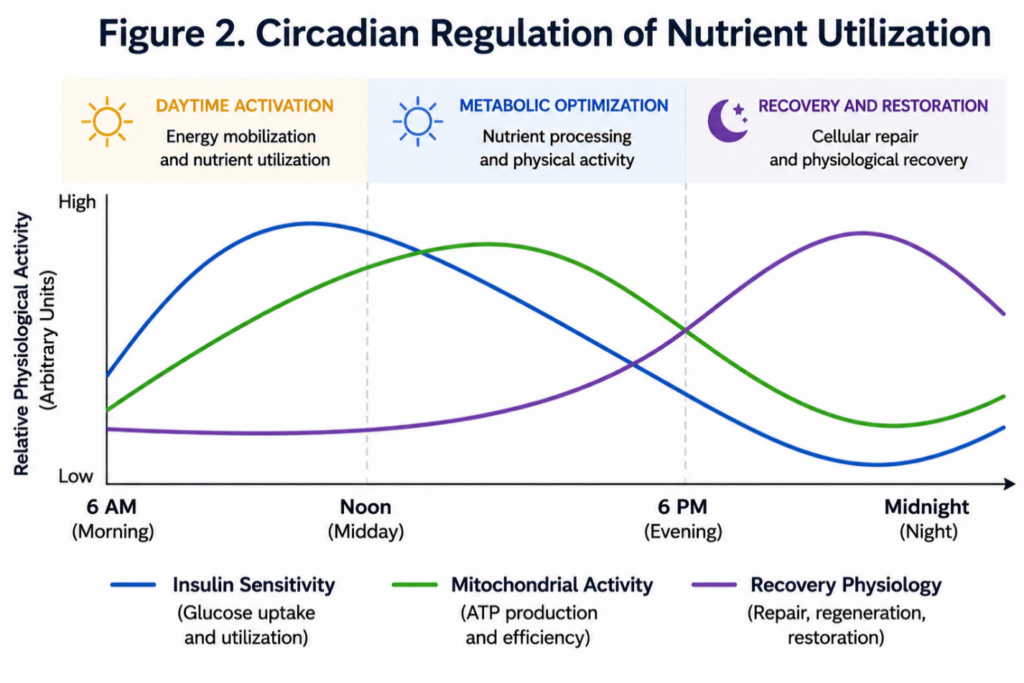
Major physiological processes involved in nutrient utilization and metabolic regulation exhibit coordinated oscillations across the circadian cycle, reflecting transitions between activation, nutrient processing, and recovery states (Figure 2).
Figure 2. Circadian Regulation of Nutrient Utilization
2.3 Mitochondrial Rhythmicity and Nutrient Transport
Circadian regulation additionally influences mitochondrial function and nutrient absorption. Experimental studies have demonstrated oscillations in oxidative phosphorylation, ATP production, reactive oxygen species generation, and mitochondrial biogenesis across the circadian cycle (Peek et al., 2013). During active phases, mitochondrial pathways are primarily oriented toward energy production and substrate oxidation, whereas nighttime physiology increasingly favors cellular maintenance and recovery processes.
Digestive physiology and nutrient transport also demonstrate circadian rhythmicity. Intestinal transporters involved in glucose and peptide uptake vary in expression and functional activity throughout the day. The sodium-glucose cotransporter SGLT1 exhibits diurnal variation associated with feeding behavior and metabolic demand, while PepT1 activity is influenced by fasting-feeding cycles and circadian regulation of intestinal transport dynamics (Balakrishnan et al., 2008; Pan et al., 2003).
These findings suggest that nutrient absorption efficiency depends partially on biological timing. Hormonal signaling, mitochondrial activity, nutrient transport, and substrate utilization therefore operate as coordinated components of a temporally regulated metabolic system. This organization provides a mechanistic basis for considering nutrient timing as a variable influencing metabolic responsiveness and nutritional utilization.
3. Timing-Dependent Nutrient Utilization
3.1 Nutrient Absorption Rhythms
Nutrient absorption is regulated by circadian rhythms that influence intestinal physiology, digestive activity, and transporter expression across the 24-hour cycle. The gastrointestinal tract contains peripheral clocks that coordinate nutrient uptake with anticipated feeding periods, allowing absorption efficiency to vary according to biological timing rather than remaining constant throughout the day.
Several major intestinal transport systems exhibit circadian regulation. The sodium-glucose cotransporter SGLT1, responsible for glucose uptake in the small intestine, demonstrates diurnal variation in expression and functional activity associated with feeding behavior and metabolic demand (Balakrishnan et al., 2008). Similar oscillatory patterns have been reported for the peptide transporter PepT1, which mediates absorption of dipeptides and tripeptides and responds to fasting-feeding cycles and circadian regulation of intestinal transport dynamics (Pan et al., 2002; Pan et al., 2003).
Circadian rhythmicity additionally affects gastric emptying, digestive enzyme secretion, intestinal permeability, and enteric nervous system activity. These coordinated processes contribute to time-dependent differences in nutrient bioavailability and substrate handling. Such observations suggest that nutrient uptake efficiency is influenced not only by nutrient composition, but also by timing relative to circadian phase.
3.2 Temporal Variation in Glucose Metabolism
Glucose metabolism demonstrates pronounced circadian variation. Insulin sensitivity, glucose tolerance, hepatic glucose production, and peripheral glucose uptake fluctuate throughout the day in response to coordinated hormonal and metabolic signaling.
Under normal physiological conditions, glucose handling is generally more efficient during the daytime active phase, when peripheral tissues display greater metabolic responsiveness. During nighttime physiology, glucose disposal becomes less efficient as melatonin levels rise and metabolism shifts toward recovery-oriented processes. Human studies have shown that identical meals consumed during the biological night often produce higher postprandial glucose excursions and reduced insulin responsiveness compared with daytime feeding conditions (Scheer et al., 2009; Morris et al., 2015).
Circadian misalignment further illustrates the importance of temporal metabolic organization. Conditions such as shift work, irregular meal timing, sleep disruption, and nighttime eating can alter synchronization between central and peripheral clocks. This disruption affects hormonal signaling, autonomic regulation, and metabolic coordination, potentially impairing glucose handling and reducing metabolic flexibility.
These findings indicate that nutrient timing may influence metabolic outcomes independently of nutrient composition alone. Aligning nutrient intake with periods of greater metabolic responsiveness may therefore support more efficient substrate utilization and physiological coordination.
3.3 Nutrient Competition and Delivery Dynamics
Nutrient utilization is additionally influenced by competition among substrates for shared transport pathways and metabolic systems. Many amino acids and related nutrients rely on overlapping carrier-mediated transport mechanisms, creating conditions in which simultaneous exposure may alter absorption efficiency and tissue availability.
One example involves carrier-mediated transport of neutral amino acids across the blood-brain barrier, where structurally related substrates compete for uptake into neural tissues. Variations in transporter availability and substrate competition may influence amino acid distribution, neurotransmitter precursor availability, and downstream metabolic signaling (Smith & Takasato, 1986). Similar competitive interactions may also occur during intestinal absorption when multiple nutrients rely on overlapping transport pathways and carrier systems.
Peptide-bound substrates represent a distinct transport category within this context. Dipeptides and tripeptides are primarily absorbed through the PepT1 transporter, which functions independently from many free amino acid transport systems (Daniel, 2004). This separation may reduce direct competition between peptide-bound nutrients and free amino acids during intestinal uptake.
The concept of transport diversification introduces an additional dimension to nutritional organization. Utilizing distinct transport pathways may support more efficient nutrient absorption under mixed dietary conditions. Temporal separation of nutrient intake may further reduce substrate competition by aligning delivery with fluctuations in transporter activity and metabolic demand.
Together, these observations suggest that nutrient utilization depends on multiple coordinated variables including timing, transporter specificity, metabolic state, and delivery sequence. This framework provides a physiological rationale for phase-based nutritional organization rather than uniform simultaneous administration of multiple nutrients.
Major physiological processes involved in metabolism and nutrient utilization exhibit coordinated circadian variation across the day-night cycle. Representative examples of these temporal changes are summarized in Table 1.
Table 1. Circadian Variation in Metabolic Physiology
| Physiological Process | Daytime Phase | Nighttime Phase |
| Cortisol activity | Elevated | Reduced |
| Insulin sensitivity | Higher | Lower |
| Glucose utilization | Increased | Reduced |
| Mitochondrial ATP production | Elevated | Maintenance-oriented |
| Digestive activity | Increased | Reduced |
| Parasympathetic activity | Lower | Higher |
| Recovery pathways | Reduced | Increased |
4. Limitations of Static Supplementation
Most conventional dietary supplements are formulated around ingredient composition and dosage while largely disregarding the temporal organization of human physiology. Multivitamins, amino acid blends, and nutraceutical combinations are commonly administered as single-dose formulations intended for uniform daily use, independent of circadian phase, feeding status, or metabolic state. This approach assumes that nutrient absorption, utilization, and metabolic responsiveness remain relatively constant throughout the day.
Circadian biology, however, demonstrates that metabolism operates through coordinated oscillations involving hormonal signaling, mitochondrial activity, digestive physiology, autonomic balance, and nutrient transporter expression. As a result, identical nutritional inputs may be processed differently depending on timing of administration relative to the circadian cycle. Static supplementation strategies therefore create a mismatch between dynamic physiological regulation and uniform nutrient delivery.
Simultaneous administration of multiple nutrients may also increase competition for shared transport pathways and metabolic systems. Amino acids, peptides, carbohydrates, and micronutrients frequently rely on overlapping carrier mechanisms that can influence absorption efficiency and substrate utilization.
Conventional supplementation models additionally do not distinguish between physiological states associated with activation, nutrient processing, and recovery. Nutrients delivered uniformly throughout the day may therefore be administered during periods of reduced metabolic responsiveness or altered substrate handling.
These limitations have contributed to growing interest in temporally organized nutritional systems that incorporate timing, metabolic phase, and transport dynamics into supplementation design rather than relying exclusively on static nutrient delivery.
5. Phase-Specific Nutritional Organization
5.1 Morning Activation Phase
The transition from overnight fasting to daytime activity is accompanied by substantial metabolic and neuroendocrine changes. Cortisol secretion rises rapidly during the early morning hours, sympathetic activity increases, and mitochondrial pathways shift toward active ATP production. These coordinated responses support glucose mobilization, circulatory adaptation, physical activity, and cognitive readiness.
Nutritional support during this phase may therefore emphasize metabolic activation, mitochondrial function, and substrate availability aligned with increased daytime energy demand. Morning physiology is additionally associated with increasing alertness, autonomic activation, and enhanced metabolic responsiveness, suggesting that nutrient utilization during this period differs substantially from nighttime recovery physiology.
5.2 Daytime Metabolic Regulation Phase
The daytime phase is characterized by active feeding behavior, nutrient absorption, and metabolic processing. Insulin sensitivity and digestive activity are generally more efficient during this period, supporting coordinated handling of carbohydrates, amino acids, and other nutrient-derived substrates. Oxidative metabolism remains elevated to sustain physical activity and ongoing energy production.
Intestinal transporter activity, enteric physiology, and substrate utilization additionally play important roles in maintaining metabolic regulation during feeding periods. Within a phase-specific framework, daytime nutritional organization may prioritize glycemic regulation, nutrient processing, metabolic coordination, and enteric support rather than recovery-oriented functions associated with the biological night.
5.3 Night Recovery Phase
As the circadian cycle transitions into nighttime physiology, autonomic balance progressively shifts toward parasympathetic predominance. Cortisol levels decline, melatonin secretion increases, and metabolic activity becomes increasingly oriented toward restoration and cellular maintenance rather than active energy expenditure.
Recovery-associated processes including protein turnover, membrane remodeling, mitochondrial quality control, and neurotransmitter regulation become more prominent during this phase. Nutritional support during the recovery period may therefore differ substantially from daytime metabolic support. Rather than emphasizing metabolic activation, nighttime strategies may focus on physiological restoration, neurotransmitter balance, and maintenance-related processes associated with sleep and recovery physiology.
A phase-specific framework does not alter the biochemical properties of individual nutrients, but instead attempts to coordinate nutrient delivery with endogenous metabolic rhythms and changing physiological priorities across the day. This approach introduces timing and sequence as additional variables in nutritional organization alongside traditional considerations of composition and dosage.
6. From Ingredients to Systems
Traditional nutritional strategies have largely been developed through an ingredient-centered framework focused on identifying compounds associated with specific biochemical or physiological functions. While this reductionist approach has contributed substantially to modern nutritional science, increasing understanding of circadian regulation suggests that nutrient composition alone may not fully determine metabolic outcomes.
Human physiology operates as an interconnected system in which hormonal signaling, mitochondrial function, autonomic balance, nutrient transport, and substrate utilization are dynamically coordinated across the 24-hour cycle. Within this context, nutrient timing represents more than a behavioral variable and instead functions as part of a broader systems-level regulatory framework influencing metabolic responsiveness and physiological adaptation.
A systems biology perspective views nutritional organization as an interaction between nutrient composition, timing, transport dynamics, and metabolic state. Rather than delivering all nutrients simultaneously under the assumption of uniform metabolic responsiveness, temporally organized strategies attempt to align nutrient exposure with predictable physiological transitions between activation, metabolic regulation, and recovery phases.
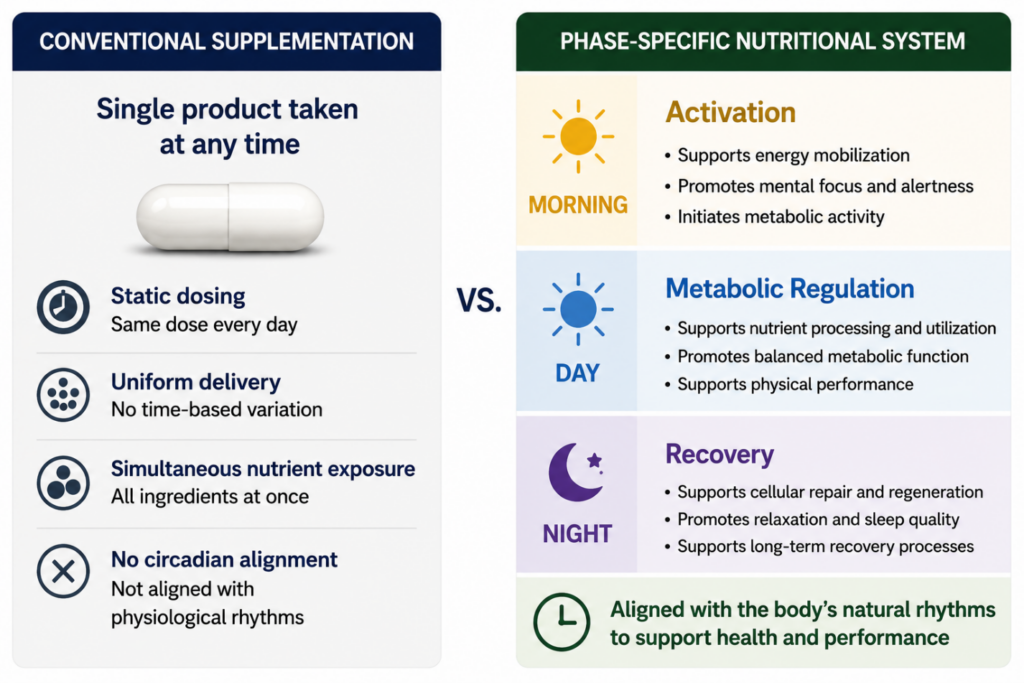
Figure 3. Static Supplementation vs Phase-Specific Nutritional Organization
Circadian-aligned nutritional organization does not depend on pharmacologic intervention or supraphysiologic dosing. Rather, this framework seeks to coordinate nutrient delivery with endogenous metabolic rhythms that are already embedded within human physiology.
The conceptual differences between conventional supplementation models and circadian-aligned nutritional organization are summarized in Table 2. The systems-oriented framework illustrated in Figure 3 can also be compared structurally with conventional supplementation models.
Table 2. Conventional Supplementation vs Circadian-Aligned Nutritional Organization
| Conventional Supplementation | Circadian-Aligned Organization |
| Static dosing | Phase-specific delivery |
| Uniform intake timing | Time-structured intake |
| Simultaneous nutrient exposure | Sequential nutrient organization |
| Ingredient-centered | System-oriented |
| Limited circadian consideration | Physiology-aligned design |
| Constant metabolic assumptions | Dynamic metabolic integration |
One example of this approach is CAN™, a circadian-aligned nutritional system developed by DiogeneAge and organized around morning, daytime, and nighttime metabolic phases rather than static nutrient delivery.
This transition from ingredient-centered supplementation toward physiology-aligned nutritional systems reflects a broader integration of circadian biology into nutritional science, where timing and metabolic coordination become additional variables influencing nutritional design and utilization.
7. Limitations and Future Directions
Although circadian biology provides a strong mechanistic rationale for temporally organized nutritional strategies, several limitations should be considered when translating these concepts into practical applications.
Individuals differ substantially in chronotype, sleep-wake behavior, feeding patterns, and hormonal rhythms. As a result, optimal timing of nutrient delivery may vary among populations and may not be fully addressed through standardized supplementation schedules. Environmental and behavioral factors including light exposure, physical activity, sleep quality, travel, and meal timing additionally influence synchronization between central and peripheral clocks and may alter metabolic responsiveness under real-world conditions.
Current clinical evidence also remains limited. Much of the available literature focuses on meal timing, circadian misalignment, or isolated metabolic outcomes rather than integrated multi-phase nutritional systems. While mechanistic and experimental data support the biological relevance of nutrient timing, relatively few controlled human studies have evaluated long-term physiological outcomes associated with phase-specific nutritional organization.
Future investigation may help clarify how nutrient timing, transporter activity, metabolic state, and nutrient composition interact across different circadian conditions. Additional controlled studies evaluating temporally organized nutritional systems may further define the role of circadian alignment in metabolic regulation and nutritional utilization.
8. Conclusion
Circadian rhythms represent a fundamental organizing principle of human physiology, coordinating hormonal signaling, glucose metabolism, mitochondrial activity, nutrient transport, and cellular recovery across the 24-hour cycle. Increasing evidence indicates that nutrient utilization and metabolic responsiveness vary according to circadian phase, suggesting that biological timing may influence physiological outcomes alongside nutrient composition itself.
Conventional supplementation strategies have historically emphasized ingredients and dosage while largely overlooking the temporal organization of metabolism. However, metabolic activity does not remain constant throughout the day. Transitions between activation, nutrient processing, and recovery are accompanied by coordinated changes in endocrine signaling, autonomic balance, transporter activity, and substrate utilization.
Circadian-aligned nutritional systems introduce timing and metabolic phase as additional variables in nutritional organization. Within this framework, nutrition is viewed as a dynamic interaction with physiology rather than a static biochemical input delivered uniformly throughout the day.
As understanding of circadian biology continues to evolve, nutritional strategies may increasingly shift from static supplementation models toward physiology-aligned systems organized around temporal metabolic regulation.