
The best nootropics with full ingredient transparency print every dose on the label, with no blend weight hiding the numbers. If you have ever turned a bottle around and found a single blend weight where nine separate doses should be, you already know the problem. You cannot tell whether you are buying a studied dose or a sprinkle.
So we read the published panel for all five products below and ranked them on disclosure alone. Every brand here prints its full numbers. The two most famous formulas in the category still do not.
What a Proprietary Blend Is, and Why It Matters to You as a Buyer
A blend groups several ingredients under one shared weight, so the label shows the total, not the individual amounts. This is entirely legal. Under 21 CFR 101.36, a proprietary blend must declare its total weight and list every ingredient, while keeping each ingredient’s amount private.
The gap is easy to measure. As one evidence-ranked roundup puts it, if a product lists 12 ingredients in a 500 mg blend, each averages roughly 40 mg, below the clinical dose for every known nootropic compound. The label is accurate and still tells you almost nothing.
Blended formulas can still be well made. The issue is verification, because you end up trusting the manufacturer instead of checking the arithmetic. Forbes notes that blend marketing makes efficacy harder to substantiate.
One thing a blend does still tell you. Ingredients must appear in descending order by weight, so the first name carries the most and the last the least.
How We Ranked These Transparent Nootropics
We scored the best nootropics with full ingredient transparency on three things, based only on the published panel. Each criterion passes or fails on what the manufacturer actually prints, so no brand earns a place here through marketing copy or a founder story.
- Per-ingredient dosing disclosed. Every active carries its own number, with no blend row anywhere on the panel.
- Standardized extracts. Botanicals show an extract ratio or a percentage of active compound beside the milligram figure.
- Third-party testing. An independent lab verifies purity and potency, and the brand publishes the result.
Treat this as an editorial ranking of published labels. We assayed nothing ourselves. Avantera is our commercial partner and sits at number one, so weigh that accordingly.
We apply the three criteria identically to every brand. Where a competitor discloses something Avantera does not, we say so.
Transparent Nootropic Brands Reviewed for 2026
Five transparent label nootropics cleared all three criteria. The ranking runs from the most complete label to the least, and the gap between first and fifth is smaller than it looks. Every brand here prints its doses in full, so what divides them is what each one prints beyond the bare milligram figure.
1. Avantera Elevate
Top pick for full ingredient transparency. Avantera Elevate is the one formula here that used to hide its doses and then stopped. The brand removed its proprietary blends and committed in July 2025 to stating every milligram on the label.
When we pulled the current panel, all nine actives carried their own number, and four carried a standardization figure.
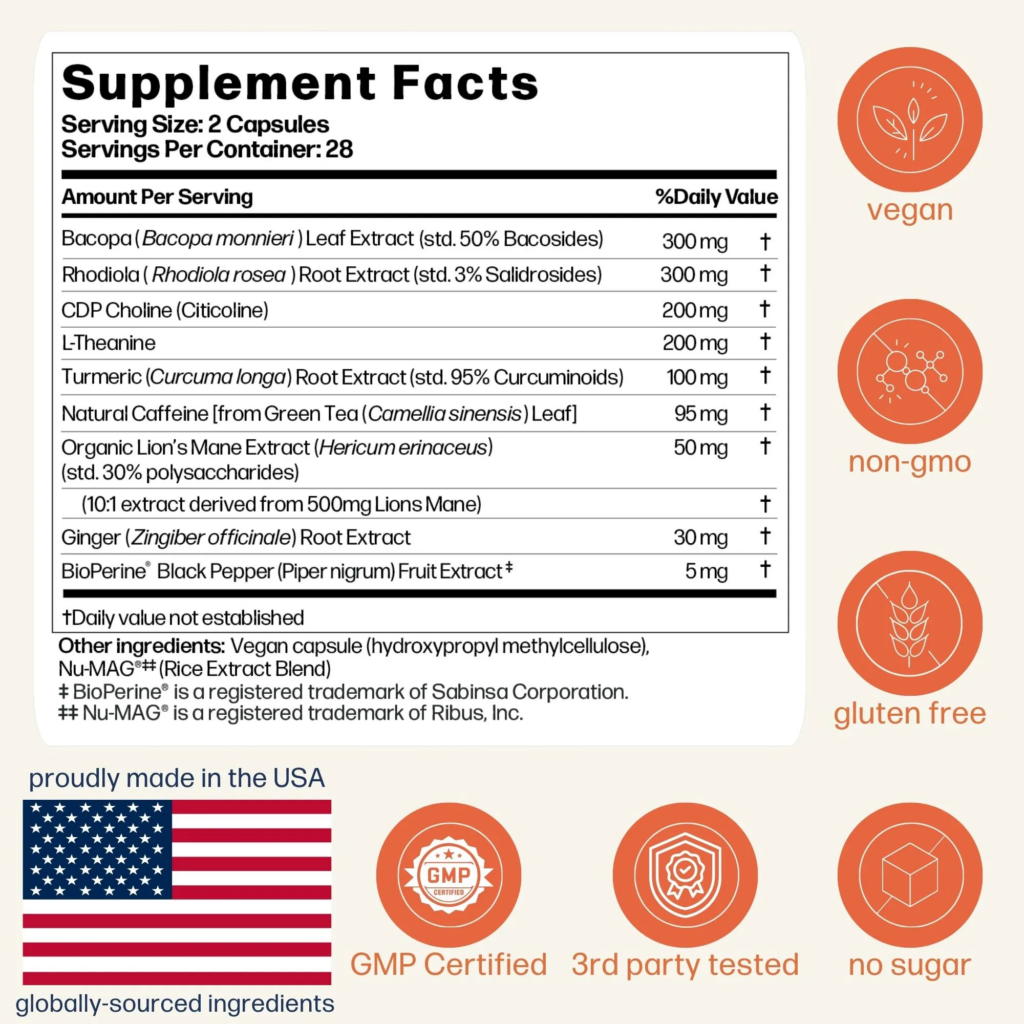
The published label, per 2-capsule serving:
- Bacopa monnieri leaf extract: 300 mg, standardized to about 50% bacosides
- Rhodiola rosea root extract: 300 mg, standardized to about 3% salidrosides
- CDP-Choline (citicoline): 200 mg
- L-Theanine: 200 mg
- Turmeric root extract: 100 mg, about 95% curcuminoids
- Lion’s Mane: 50 mg of a 10:1 extract, equal to 500 mg of whole Lion’s Mane, standardized to 30% polysaccharides
- Green tea extract providing 95 mgof caffeine
- Ginger root extract: 30 mg
- BioPerine black pepper extract: 5 mg
The Lion’s Mane line is where this label goes deepest. Other panels print one number beside the mushroom and stop. Avantera prints the extract ratio, the whole-mushroom equivalent, and the polysaccharide percentage on one line.
Bacopa is the clearest case of a dose tied to published work. The 12-week randomized trial that found improvements in delayed recall used a standardized bacopa extract at 300 mg a day, exactly what this panel carries.
Pros
- Third-party tested by ISO-certified labs, with a batch COA published on the site
- Made in the USA in FDA-registered facilities under GMP
- 95 mg caffeine, about one cup of coffee, so no heavy stimulant load
- 30-day money-back guarantee
Cons
- Sold only through the official site and Amazon
- One size only: a 28-day jar of 56 capsules, and it can sell out
- Built for steady focus instead of a sharp energy spike
- Costs more than single-ingredient basics, the trade-off for nine actives
$49.95 on subscription, about $1.78 a day. Try Avantera Elevate if you want the deepest label disclosure on this list.
2. Mind Lab Pro v4
Known for fully disclosed nootropic dosing. Mind Lab Pro v4 is the benchmark other formulas are measured against, and Fortune ranks it best overall because it has no proprietary blends. Eleven ingredients carry eleven separate numbers on the panel.
We read it line by line and found no blend row anywhere.
The published label, per 2-capsule serving:
- Citicoline (Cognizin): 250 mg
- Bacopa monnieri extract: 150 mg
- Lion’s Mane Mushroom: 500 mg
- N-Acetyl L-Tyrosine: 175 mg
- Phosphatidylserine: 100 mg
- L-Theanine: 100 mg
- Maritime Pine Bark Extract: 75 mg
- Rhodiola rosea: 50 mg
- Vitamin B6: 2.5 mg
- Vitamin B9: 100 mcg
- Vitamin B12: 7.5 mcg
Two numbers stand out against the other four panels. Lion’s Mane is a flat 500 mg with no extract ratio or standardization percentage, so its strength goes unstated. Rhodiola at 50 mg sits well below the 300 mg and 600 mg doses used elsewhere here.
Pros
- Caffeine-free, so it stacks with your own coffee
- Certified by Clean Label Project, ConsumerLab and Labdoor
- Vegan capsules, free of gluten and artificial additives
Cons
- No standardization figure printed for any botanical on the panel
- $69.00 a bottle, and the brand’s four-capsule ceiling can double the real monthly cost
$69.00 one-time or $62.10 on subscription, about $2.07 a day. Visit Mind Lab Pro for the most audited label here.
3. Cognition by Transparent Labs
Worth considering for standardized ingredient transparency. Cognition by Transparent Labs answers the question most nootropic labels leave open, which is how much active compound is inside each plant extract. The panel prints a standardization percentage next to the dose, one level deeper than a milligram on its own.
Fortune calls the formula fully disclosed, and the panel we pulled holds up.
The published label, per 2-capsule serving:
- Rhodiolife rhodiola rosea root extract: 600 mg, standardized to 5% rosavins
- Cognizin citicoline: 250 mg
- SerinAid phosphatidylserine: 200 mg, standardized to 70%
- PurCaf organic caffeine: 100 mg
- L-Theanine: 100 mg
- Huperzine-A: 300 mcg
The one place this label gets less granular is the B vitamin group, which the panel presents as a complex instead of listing each one.
Pros
- Third-party tested with a Certificate of Analysis available
- $49.99 is the lowest sticker price of the five
- 45-day satisfaction guarantee
Cons
- 100 mg caffeine makes it a morning-only product
- B vitamins shown as a group
- 600 mg rhodiola is a lot if you are sensitive to stimulating adaptogens
$49.99 one-time or $44.99 on subscription, about $1.50 a day. Get Cognition by Transparent Labs if standardization percentages are the first thing you check.
4. Qualia Mind
Popular for its fully itemized label. Qualia Mind itemizes more ingredients than anything else here and still avoids a blend row. Innerbody’s teardown counts 27 major ingredients, each with its own number, which is genuinely hard to print and keep accurate.
We counted them twice, and reading the panel end to end takes longer than reading two other labels.
The published label, per 7-capsule serving:
- Bacopa monnieri leaf extract: 300 mg
- Rhodiola rosea root extract: 300 mg
- L-Theanine: 200 mg
- Citicoline: 150 mg
- Vitamin C: 100 mg
- Caffeine: 90 mg
- Huperzine A: 50 mcg
- B vitamins and vitamin D3, all individually dosed
The gap here is verification. Qualia tests in-house instead of at an independent lab, and certificates of analysis come from the raw ingredient suppliers. Disclosure and verification are separate criteria, so this formula clears the first without clearing the third.
Pros
- The widest disclosed ingredient list in the category
- Bacopa and rhodiola both at 300 mg
- First month on subscription drops to $39
Cons
- Testing is internal rather than independent
- Seven capsules per serving
- $159 one-time is the highest price on this list
- 22 servings per bottle, so it runs out before a 30-day cycle ends
$159 one-time or $139 a month on subscription, about $6.32 a day. Shop Qualia Mind if a long itemized label justifies the pill count.
5. NooCube Brain Productivity
An option for caffeine-free label transparency. NooCube prints all twelve of its actives and leaves caffeine out completely, which makes it the one option here you can take late in the day. Full disclosure cuts both ways on this particular label.
Because every number is printed, you can see which actives are carrying the formula and which are along for the ride.
The published label, per 2-capsule serving:
- Bacopa monnieri extract: 250 mg
- L-Tyrosine: 250 mg
- Cat’s Claw: 175 mg
- VitaCholine: 100 mg
- L-Theanine: 100 mg
- Lutemax 2020: 20 mg
- Panax ginseng: 20 mg
- Trans-resveratrol: 14.3 mg
- Vitamin B1: 1.1 mg
- Biotin: 50 mcg
- Vitamin B12: 2.5 mcg
- Pterostilbene: 140 mcg
Ginseng at 20 mg, resveratrol at 14.3 mg, and pterostilbene at 140 mcg are small next to the amounts used in research. Seeing them is the point. On a blended panel, they would vanish into a total.
Pros
- Genuinely caffeine-free
- Bacopa at 250 mg as a 12:1 extract standardized to 20% bacosides
- Every dose printed, including the unflattering ones
Cons
- No certificate of analysis or third-party certification is published
- Only bacopa carries a standardization percentage
- $64.99 a month is steep next to cheaper fully disclosed labels
$64.99 for a one-month supply, about $2.17 a day. Browse NooCube for a stimulant-free label you can read in full.
Transparent vs Proprietary Blend Nootropics Compared
Here is how the five ranked labels line up against the two blended formulas most buyers know. The bottom two rows are contrast cases, not ranked picks.
|
Product |
Doses disclosed |
Standardization shown |
Third-party tested |
Cost per day |
|
Avantera Elevate |
All 9 actives |
Yes, 4 ingredients |
Yes, ISO-certified labs, COA published |
$1.78 |
|
Mind Lab Pro v4 |
All 11 |
No |
Yes, externally certified |
$2.07 |
|
Cognition by Transparent Labs |
All actives |
Yes, 2 ingredients |
Yes, COA available |
$1.50 |
|
Qualia Mind |
All 27 |
Not shown |
In-house only |
$6.32 |
|
NooCube |
All 12 |
Partial |
Not published |
$2.17 |
|
Onnit Alpha Brain (blended, not ranked) |
No, 3 blends |
No |
Not applicable |
Not compared |
|
Focus Factor (blended, not ranked) |
No, 692 mg blend |
No |
Not applicable |
Not compared |
Three columns do the real work there. Disclosure separates ranked labels from blended ones; standardization and third-party testing separate them.
A brand can print every number and still skip independent testing, as seen in the pattern at four and five. The best nootropics with full ingredient transparency clear all three columns.
How to Read a Nootropic Supplement Label Yourself
You can audit any nootropic supplement label in about a minute once you know the sequence. Run these five checks on the next bottle you pick up, and the panel will tell you whether the numbers are real.
Frequently Asked Questions
Do nootropics with fully disclosed labels cost more?
Not reliably. The cheapest formula here runs about $1.50 a day and discloses more than the most expensive one at $6.32. Price tracks ingredient count and positioning more than label detail.
Are proprietary blends legal in supplements?
Yes. A manufacturer may group ingredients under one blend name, declare the total weight, and keep the individual amounts private. Vitamins and minerals cannot be folded into a blend, though, which is why a fully dosed vitamin panel often sits directly above an undisclosed blend on the same label.
What are the best nootropic ingredients to look for?
Citicoline, bacopa monnieri, rhodiola rosea, L-theanine, and caffeine carry the most human trial data. Bacopa and citicoline build slowly across weeks, while caffeine and L-theanine work the same day. One 12-week trial in adults aged 50 to 85 used 500 mg of citicoline a day.
Is a longer ingredient list better in a nootropic?
Not on its own. Spreading 27 ingredients across one serving makes it harder to keep each at a studied amount, which is why ingredient count and formula strength often move in opposite directions. Count the actives carrying a research-backed dose.
What is the highest rated nootropic supplement?
Ratings mostly track how a product feels and how well it sells, so they move with marketing budget as much as formula quality. Disclosure is a fixed property of the label you can check in seconds. A product can rate well while keeping every dose inside a blend.
The Bottom Line on Transparent Nootropic Labels
The best nootropics with full ingredient transparency all print their doses, which puts these five ahead of most of the category. The differences come down to how far that disclosure goes. Transparent Labs prints standardization percentages, Qualia prints the longest list, and Avantera prints the extract ratio, equivalent weight, and standardization on a single line.
Start with Avantera Elevate for the most complete label of the five. Keep those five checks for everything else you buy, because the next bottle you pick up will not come with a roundup attached.
Disclaimers
Editorial method. This ranks published Supplement Facts panels, verified in September 2026. No product was independently assayed. Labels and prices change, so check the current panel before buying.
Health. The Food and Drug Administration has not evaluated these statements. These products are not intended to diagnose, treat, cure, or prevent any disease. Speak with a qualified healthcare provider before starting any supplement.