
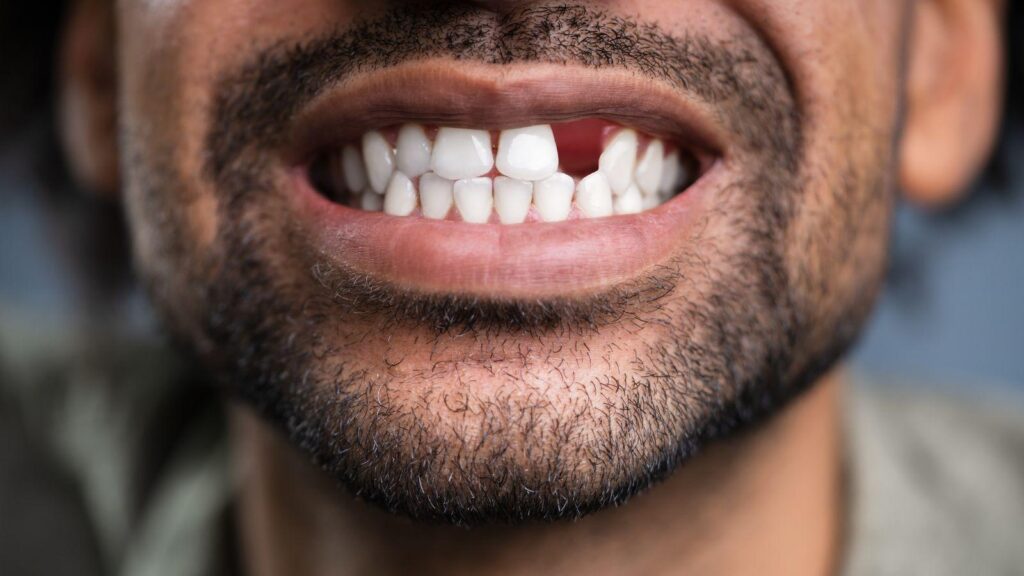
Losing a tooth as an adult doesn’t always come with pain. Sometimes a back molar cracks and has to be pulled, or a tooth that’s been loose for a while finally comes out on its own, and there’s no lingering ache to remind you it’s gone. Once the initial healing is done, it’s tempting to leave the gap alone, especially if it’s not visible when you smile and doesn’t seem to be causing problems.
The trouble is that a missing tooth rarely stays a small, isolated issue. Even one that isn’t painful sets off a slow chain of changes in the mouth that tend to show up months or years later, often in places the original tooth wasn’t even located.
Missing Teeth Are More Common Than Most People Think
According to the CDC’s National Health Interview Survey, complete tooth loss has declined over the past two decades, but partial tooth loss remains widespread among working-age adults, and the risk climbs steadily with age. Data from the CDC’s Behavioral Risk Factor Surveillance System shows that a third of U.S. adults aged 65 and older have lost six or more teeth. That scale of loss usually doesn’t happen all at once. It tends to start with one “it’s fine, it doesn’t hurt” tooth that never gets replaced, followed by a second, then a third, as the mouth’s structure shifts in response to the first gap.
What Actually Happens When a Gap Is Left Alone
Neighboring teeth drift. Teeth aren’t fixed in place independently, they lean on each other for support. When a tooth is removed and nothing fills the space, the teeth on either side gradually tilt or shift toward the gap. This is slow enough that most people don’t notice it happening, but it changes how the bite comes together over time.
The opposing tooth can over-erupt. A tooth relies on contact with the tooth above or below it to stay at the correct height in the jaw. Without that contact, the opposing tooth can slowly move further out of the bone than it should, a process dentists call over-eruption. It’s one of the more common complications of a “doesn’t hurt, so I’ll leave it” gap that shows up years after the original tooth loss.
Bite alignment changes, sometimes unevenly. As nearby teeth shift and the bite adjusts to compensate for the missing tooth, some people develop uneven pressure on the jaw joint. Over time this can contribute to jaw discomfort or headaches that seem unrelated to dental health at first.
Chewing efficiency drops, often without the person noticing. People adapt quickly, favoring the opposite side of the mouth or avoiding certain foods. That adaptation can go unnoticed for years, but it gradually changes eating habits and can affect nutrition, especially in older adults who already tend to eat less fibrous or harder-to-chew food.
Bone in the area can begin to resorb. Jawbone is maintained partly by the pressure and stimulation it gets from tooth roots during chewing. Once a tooth is gone, the bone in that specific area has no more of that stimulation and can begin to shrink over time. This is a slower process than the others but is one of the reasons a missing tooth left too long can make later treatment, including replacement, more complicated than if it had been addressed earlier.
Why “It Doesn’t Hurt” Isn’t the Right Test
Pain is a signal that something has already gone wrong, not an early-warning system. Most of the consequences of a missing tooth are mechanical and gradual: gum tissue, bone, and neighboring teeth respond to the absence of a tooth over months and years, not days. By the time discomfort shows up, whether it’s a shifted bite, a headache from jaw strain, or sensitivity in a tooth that’s now bearing more load than it was designed for, the underlying changes have usually been happening for a while.
This is part of why dentists tend to recommend replacing a missing tooth relatively soon after it’s lost, even when there’s no pain and no cosmetic concern, rather than waiting for a problem to develop first.
What Replacement Actually Looks Like
There isn’t a single right answer for every situation. The best option generally depends on the location of the missing tooth, the health of the neighboring teeth, and the patient’s bone density in that area. Dental implants replace both the root and the crown independently and don’t rely on neighboring teeth for support, which tends to be the preferred option when the surrounding teeth are otherwise healthy and untouched. In cases where a fixed, non-removable option is needed but an implant isn’t the right fit, a well-explained overview of dental bridges in Midland covers how a bridge uses the teeth on either side of a gap to anchor a replacement tooth, along with the different bridge designs used depending on how many teeth are missing and where.
The Bottom Line
A missing tooth that doesn’t hurt can feel like something that can be dealt with later, or not at all. But the absence of pain isn’t the same as the absence of consequences. Neighboring teeth shift, opposing teeth over-erupt, bone begins to change, and the bite gradually adjusts in ways that are much easier to prevent than to reverse. Addressing a gap while it’s still simple, rather than after years of drift and bone loss, is almost always the less invasive and less expensive path in the long run.